
Why one metal takes 9 minutes and another takes 51min
Two parts arrive at a machine shop with identical drawings. Same shape, same tolerances, same surface finish requirements. The only difference? One is made from 6061 aluminum, and the other from 17-4 stainless steel.
The aluminum part is finished in just nine minutes. The stainless steel version takes nearly an hour, wears out multiple cutting tools, and still fails the surface finish inspection.
The drawing didn't change. The machine didn't change. The only thing that changed was the material.
That difference explains a lot about machining. The hardness and behavior of a material affect almost every machining decision—cutting speeds, feed rates, tooling, coolant, workholding, and even the order of operations. Understanding this helps manufacturers predict machining costs and performance instead of relying on trial and error.
Why Material Hardness Matters
Machining is essentially the process of removing material by forcing a cutting tool through metal and shearing off chips.
The key question is simple:
Does the material cut cleanly, or does it resist the cut?
Soft metals are generally easier to cut, but they often stick to the cutting tool. Harder metals resist cutting forces, generate more heat, and wear tools much faster.
These are very different challenges, and each requires a different machining strategy.
Hardness Isn't the Whole Story
Many people assume harder metals are always more difficult to machine. In reality, machinability depends on several factors:
- Hardness
- Strength
- Work-hardening behavior
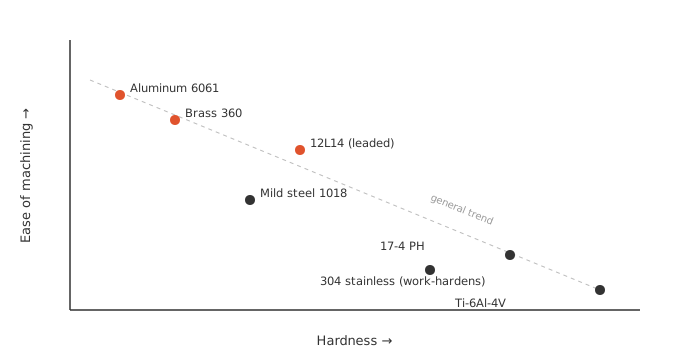
Some materials aren't especially hard but can still be difficult to machine because they become harder during the cutting process.
A common example is 304 stainless steel. It isn't the hardest metal in the shop, but it often machines worse than expected because it work-hardens very quickly.
What Happens During Cutting
At the cutting edge, the tool compresses the metal until it shears and forms a chip.
Different materials respond differently:
Aluminum and Other Soft Metals
Soft metals shear easily, creating lower cutting forces.
Benefits:
- Faster machining
- Lower tool wear
- Higher cutting speeds
Challenges:
- Long chips can wrap around tools
- Material tends to stick to the cutting edge
- Surface finish can become inconsistent
Harder Materials
Harder metals require more force to cut.
Challenges:
- Higher temperatures
- Greater tool wear
- More abrasion
- Shorter tool life
Instead of material sticking to the tool, the main concern becomes heat and edge wear.
The Built-Up Edge Problem
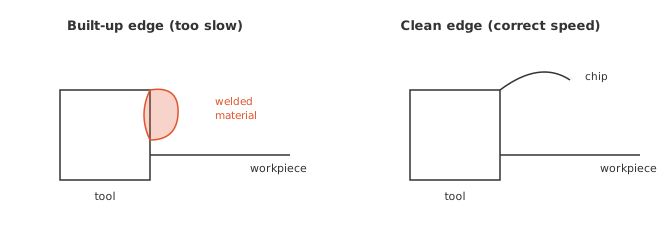
One of the biggest issues when machining soft materials is something called built-up edge.
This happens when material sticks to the cutting tool and gradually forms a layer on the cutting edge. As that layer breaks away, it can damage the tool coating and affect surface finish.
The surprising solution is often to increase cutting speed.
At higher speeds, the material is less likely to stick to the tool. This is one reason aluminum is frequently machined at speeds that would instantly destroy a tool in steel.
Higher speed isn't only about productivity—it's also about preventing built-up edge.
Why Work-Hardening Causes Problems
Materials such as 304 stainless steel and titanium become harder as they are deformed.
If the tool rubs the surface instead of cutting aggressively enough, it hardens the material underneath.
The next tool pass then has to cut through a tougher layer than before.
This often leads to:
- Poor surface finish
- Increased cutting forces
- Rapid tool wear
- Premature tool failure
The solution is counterintuitive.
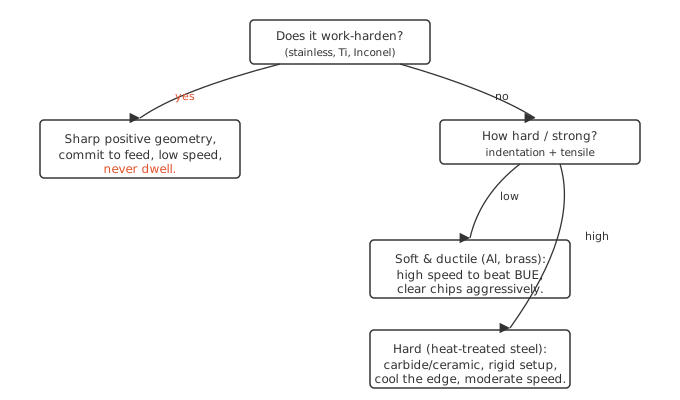
When machining work-hardening materials, avoid timid cuts. Use sharp tools and enough feed rate to stay beneath the hardened surface layer. A tool that cuts confidently often lasts longer than one that barely engages the material.
Heat Changes Everything
Different materials handle heat in different ways.
Aluminum
Most heat leaves with the chip.
Coolant is mainly used for:
- Chip removal
- Lubrication
- Preventing material from sticking
Titanium and Hard Alloys
Titanium behaves very differently.
It doesn't conduct heat well, which means heat stays concentrated at the cutting edge.
In these materials, coolant is primarily used for:
- Temperature control
- Tool protection
- Extending tool life
The "go faster" strategy that works for aluminum can quickly destroy a tool in titanium.
Soft Doesn't Always Mean Easy
Many people assume softer materials are easier to machine. That's not always true.
Very soft metals can:
- Smear instead of cut cleanly
- Produce poor surface finishes
- Deflect during machining
- Chatter more easily
Thin-walled aluminum parts, for example, can sometimes be harder to hold within tolerance than a more rigid steel part.
Easy to cut does not always mean easy to manufacture accurately.
Hard Doesn't Always Mean Expensive
Modern carbide tooling, ceramic tools, rigid CNC machines, and high-pressure coolant systems have changed the game.
Today, many hardened steels can be machined efficiently and predictably.
In some cases, machining a hardened part directly is cheaper than machining it soft and sending it for heat treatment later.
The real challenge isn't simply hardness.
It's maintaining tool life and process stability.
A well-understood hard material can often run more predictably than a soft, gummy material that causes chatter and built-up edge.
The Key Takeaway
Instead of asking, "How hard is this material?", ask:
"What machining problem is this material likely to create?"
- Soft, ductile materials tend to cause sticking, chatter, and chip control issues.
- Work-hardening materials punish tools that rub instead of cut.
- Hard materials generate heat and abrasive wear that shorten tool life.
Once you understand the material's preferred failure mode, the right machining strategy becomes much clearer.
And when it comes time to quote a job, don't focus only on hardness numbers.
The 17-4 stainless part didn't cost more simply because it was harder. It cost more because the material demanded a completely different machining approach—and the tooling, cycle time, and process had to adapt accordingly.