
FR4 CNC Machining for Semiconductor Equipment
FR4 is one of the most widely used engineering materials in the electronics and semiconductor industries. While it is best known as the base material for printed circuit boards (PCBs), FR4 is also extensively machined into precision mechanical components used throughout semiconductor equipment.
Its unique combination of electrical insulation, dimensional stability, mechanical strength, and chemical resistance makes it an ideal choice for applications where metal components are unsuitable.
Unlike aluminum or stainless steel, FR4 is a glass fiber-reinforced epoxy laminate. It consists of woven fiberglass fabric bonded with epoxy resin, creating a lightweight composite material that offers excellent electrical insulation while maintaining sufficient mechanical strength for structural and functional components.
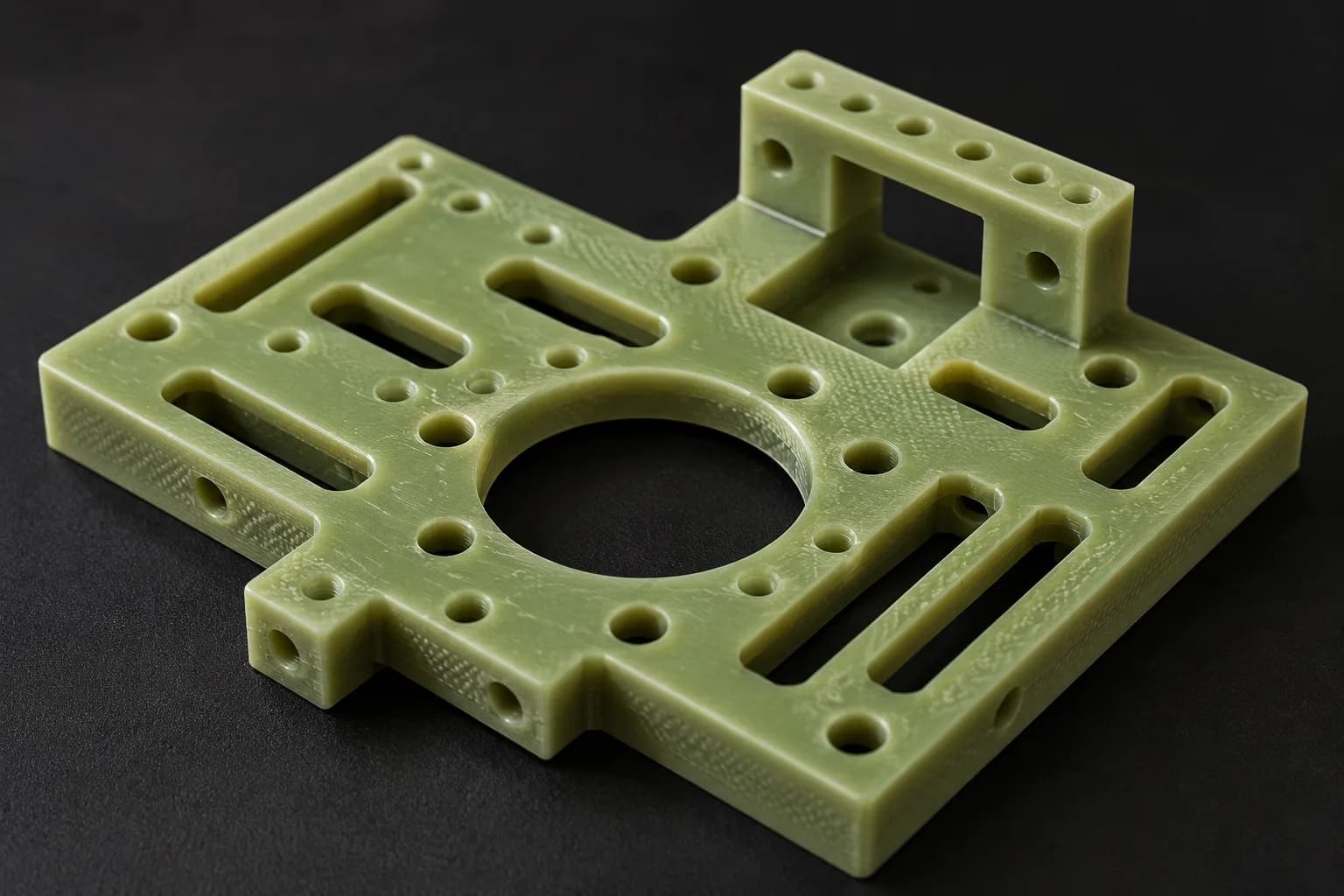
In semiconductor equipment, many components must operate near high-voltage electronics, precision sensors, RF systems, and sensitive instrumentation. Metallic parts can introduce electrical conductivity, electromagnetic interference, or unwanted grounding paths.
FR4 eliminates these concerns by providing a rigid, non-conductive material that can be precisely machined into complex geometries while maintaining excellent dimensional accuracy.
Although FR4 is easier to machine than many advanced ceramics, it presents its own manufacturing challenges. The fiberglass reinforcement is abrasive, causing rapid cutting tool wear, while improper machining parameters can lead to delamination, edge chipping, fiber breakout, or poor hole quality.
Successful FR4 machining requires specialized tooling, optimized cutting strategies, effective dust extraction, and careful inspection to produce clean, burr-free components suitable for semiconductor applications.
What Is FR4?
FR4 is a flame-retardant fiberglass-reinforced epoxy laminate widely used in electrical and electronic applications. The designation "FR" stands for Flame Retardant, while "4" identifies a specific grade defined by the National Electrical Manufacturers Association (NEMA).
FR4 combines two materials: woven fiberglass, which provides strength, stiffness, and dimensional stability, and epoxy resin, which binds the fiberglass layers together while providing electrical insulation and chemical resistance.
The result is a lightweight composite material that offers excellent mechanical performance without electrical conductivity.
Why FR4 Is Used in Semiconductor Equipment
Semiconductor manufacturing equipment contains numerous electrical systems, sensors, robotic assemblies, vacuum subsystems, and motion control components that require electrically insulating structural materials.
FR4 is commonly selected because it offers a balanced combination of:
- Excellent electrical insulation
- High mechanical strength
- Good dimensional stability
- Low moisture absorption
- Good chemical resistance
- Easy machinability
- Cost-effective manufacturing
Unlike engineering plastics that may deform under load, FR4 maintains rigidity, making it suitable for precision fixtures and mounting structures.
Typical Machining Tolerances for FR4
FR4 can be machined to high precision for semiconductor equipment, but achievable tolerances depend on part geometry, material thickness, and feature complexity.
Critical features such as precision locating holes, alignment slots, and mounting interfaces may require tighter tolerances through optimized machining strategies, specialized tooling, or secondary finishing operations.
Common Semiconductor Applications
FR4 is frequently machined into components such as:
Electrical Insulation Components
- Insulating plates
- Isolation barriers
- Terminal supports
- High-voltage mounting panels
Mechanical Fixtures
- Precision fixtures
- Assembly jigs
- Inspection fixtures
- Alignment tools
Motion System Components
- Sensor mounting brackets
- Encoder supports
- Cable guide plates
- Electrical isolation mounts
Semiconductor Equipment Parts
- PCB support plates
- Vacuum-compatible insulators
- Electrical enclosures
- Instrument mounting panels
- Protective covers
Advantages of FR4
Excellent Electrical Insulation
FR4 is electrically non-conductive, making it ideal for components installed near power electronics, sensors, and control systems.
High Dimensional Stability
The fiberglass reinforcement minimizes deformation, allowing machined parts to maintain their shape during operation.
Lightweight
Compared to metal components, FR4 significantly reduces component weight while maintaining adequate structural strength.
Chemical Resistance
FR4 resists many cleaning chemicals, oils, and industrial fluids commonly encountered in semiconductor equipment.
Easy to Machine
Compared with ceramics and glass, FR4 can be machined efficiently using CNC routers and machining centers.
CNC Machining Processes for FR4
Although FR4 is easier to machine than many advanced composites, machining parameters must be carefully controlled to avoid damaging the material. Common machining operations include:
CNC Milling
Used for: complex profiles, precision pockets, slots, mounting surfaces, custom geometries.
CNC Drilling
Used to create: through holes, blind holes, mounting holes, precision locating features.
Hole quality is especially important because fiberglass fibers can splinter if incorrect drill geometry is used.
Routing
High-speed routing is widely used to produce PCB carriers, custom insulation plates, electrical panels, and thin-walled components.
Thread Milling
Where threaded inserts or precision fastening features are required, thread milling provides better surface quality than conventional tapping.
Machining Challenges
Despite its advantages, FR4 requires specialized machining techniques.
Tool Wear
Fiberglass is highly abrasive. Standard carbide tools wear rapidly, reducing dimensional accuracy and surface quality. Diamond-coated tooling is often preferred for long production runs.
Delamination
Improper feed rates or excessive cutting forces can separate the fiberglass layers. Optimized cutting strategies reduce the risk of delamination.
Fiber Breakout
Poor tool geometry may pull fiberglass fibers from the surface instead of cutting them cleanly, resulting in rough edges and poor cosmetic quality.
Dust Generation
Machining FR4 produces fine glass dust that can damage machine components, reduce tool life, affect operator safety, and contaminate nearby production areas. Efficient dust extraction systems are essential during production.
Design Considerations
When designing FR4 components, engineers should consider:
- Avoid extremely thin unsupported walls.
- Maintain sufficient edge distance around holes.
- Use generous internal radii where possible.
- Minimize sharp internal corners.
- Consider insert hardware instead of directly threading thin sections.
- Specify realistic tolerances based on part geometry.
Good design practices improve manufacturability while reducing machining cost.
Surface Finish
Machined FR4 components typically receive precision edge finishing, deburring, surface cleaning, inspection, and protective packaging.
Additional coatings are generally unnecessary because FR4 already provides excellent insulation and chemical resistance.
Quality Inspection
Typical inspection includes dimensional verification, hole position inspection, thickness measurement, flatness inspection, visual inspection for delamination, edge quality inspection, and fiber breakout evaluation.
Critical semiconductor applications often require comprehensive dimensional reports to ensure component consistency.
Best Practices for Manufacturing FR4 Components
Successful FR4 machining depends on selecting the right cutting tools, machining parameters, and inspection methods.
Using sharp tooling, optimized cutting speeds, effective dust extraction, and proper workholding helps produce clean, burr-free components with excellent dimensional accuracy. Early Design for Manufacturability (DFM) reviews can further improve production efficiency by identifying features that simplify machining, reduce tool wear, and minimize manufacturing costs.
Conclusion
FR4 remains one of the most versatile materials for semiconductor equipment because it combines electrical insulation, mechanical strength, dimensional stability, and cost-effective manufacturability. From insulating plates and sensor mounts to precision fixtures and structural supports, CNC-machined FR4 components play a critical role in ensuring reliable equipment performance.
With the right machining strategy, tooling, and quality control, FR4 components can achieve the precision, consistency, and durability required for demanding semiconductor manufacturing environments, making them an essential material for modern semiconductor equipment.