
Inside 5-Axis Machining
A competitor may quote your aluminum flight bracket at 4.2 hours of machining time and require five separate setups. Every time a part is removed and repositioned, there's another opportunity for small errors to creep in. When you're trying to hold a tight 0.002" true-position tolerance, those errors can quickly add up. By the third or fourth setup, maintaining accuracy becomes increasingly difficult, and scrap rates often start to rise.
The same bracket on a 5-axis machine can often be completed in a single setup. That difference can significantly impact cost, quality, and lead time.
What 5-Axis Machining Is Really About
Many people associate 5-axis machining with highly complex aerospace components or intricate turbine parts. While it certainly excels at producing those geometries, its biggest advantage is often much simpler: reducing setups.
When a part stays clamped in one position throughout most or all of the machining process, accuracy improves, handling time decreases, and the risk of errors is reduced.
The Basic Concept: Two Extra Axes
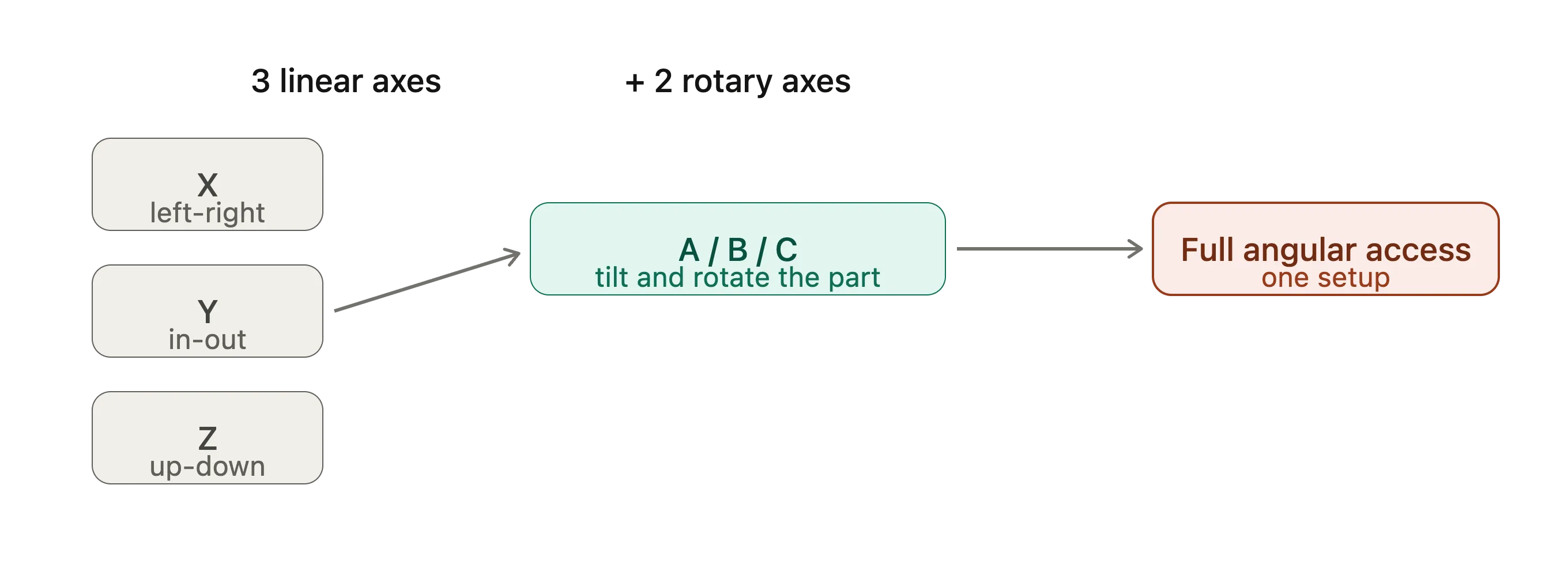
A standard CNC milling machine moves along three linear axes:
- X-axis
- Y-axis
- Z-axis
To machine features on different sides of a part, the operator must stop the machine, reposition the workpiece, and establish a new setup.
A 5-axis machine adds two rotational movements, allowing the cutting tool to approach the part from different angles without removing it from the fixture.
This capability makes it possible to machine multiple sides of a component in a single operation.
Common 5-Axis Machine Configurations
There are two common machine designs used in 5-axis machining.
Table/Table Configuration
Both rotary axes are built into the machine table. The workpiece tilts and rotates while the spindle remains stationary. This setup is often used for smaller and medium-sized components.
Table/Head Configuration
One rotary axis is located in the table, while the other is built into the spindle head. This design is often preferred for larger or heavier parts that are difficult to tilt during machining.
Two Different Ways to Use 5 Axes
Not all 5-axis machining involves continuous movement of all axes.
3+2 Positional Machining
In 3+2 machining, the machine rotates the part to a specific angle and then locks the rotary axes. Machining is performed using traditional 3-axis movements until that operation is complete.
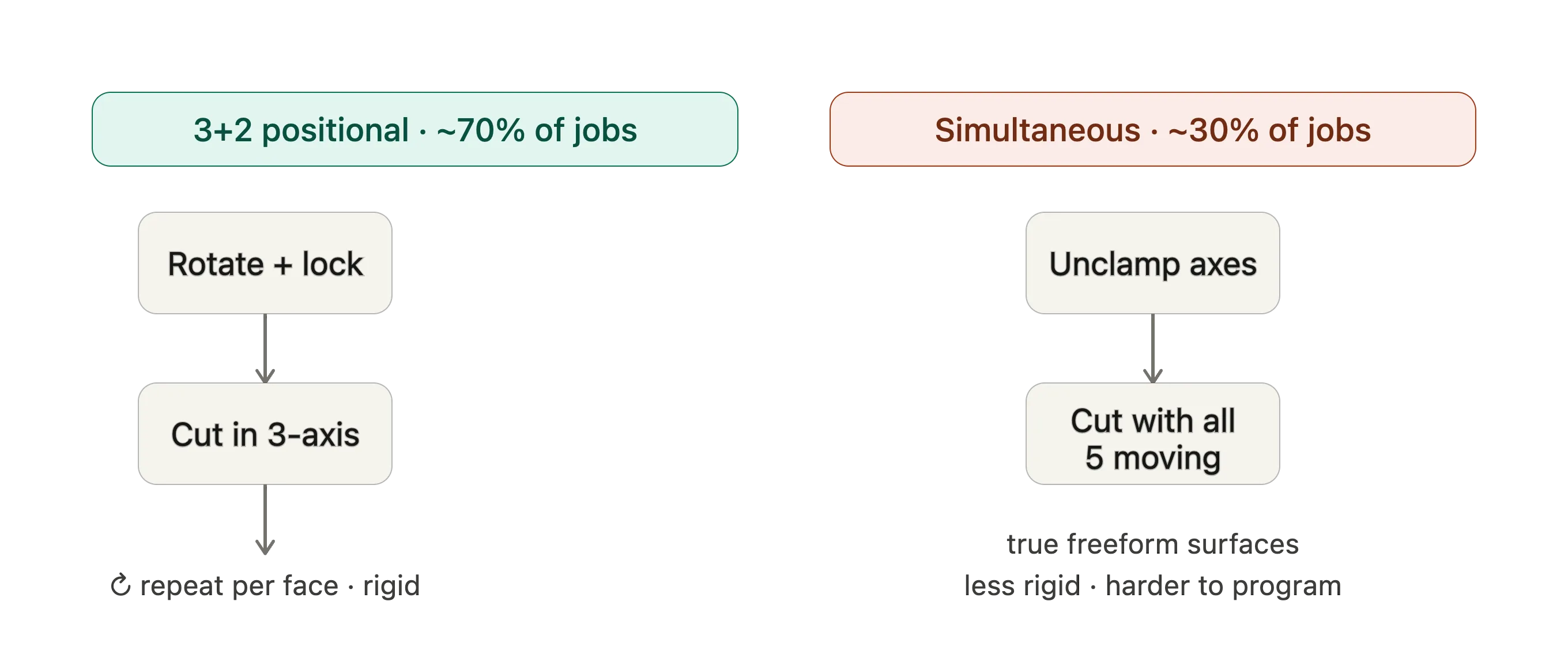
The process is then repeated for additional faces or features.
This approach is widely used because it eliminates multiple setups while keeping programming relatively straightforward.
Simultaneous 5-Axis Machining
In simultaneous machining, all five axes move continuously during the cutting process.
This method is typically used for:
- Turbine components
- Aerospace structures
- Complex molds
- Medical implants
- Freeform surfaces
While highly capable, simultaneous machining requires more advanced programming and machine control.
How Accuracy Is Maintained
As a machine tilts and rotates a part, maintaining the exact position of the cutting tool becomes increasingly important.
Modern 5-axis systems use functions such as Tool Center Point Control (TCP) and advanced work offset management to ensure the tool tip remains on the programmed path throughout the machining process.
These technologies help maintain accuracy while simplifying setup and programming.
The Trade-Offs of 5-Axis Machining
The benefits are substantial, but they come with added complexity.
More Demanding Setup Requirements
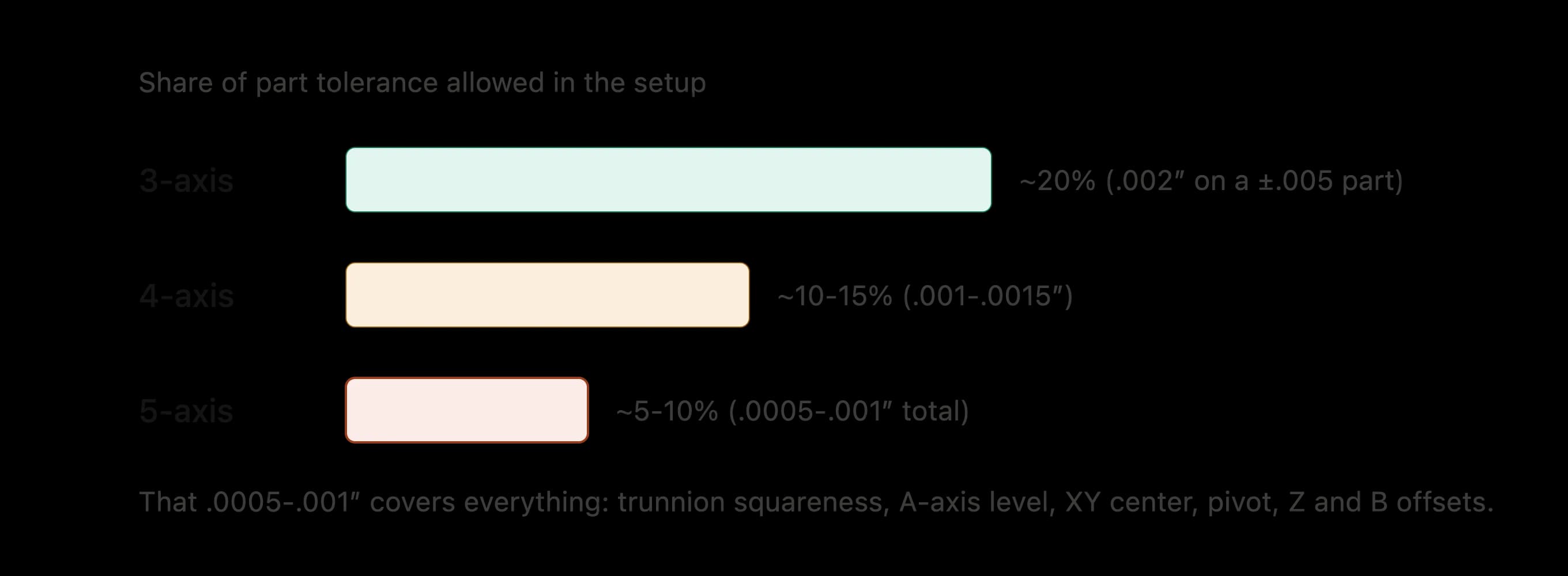
With additional rotary axes comes a greater need for precision during setup.
Machine calibration, workholding alignment, pivot locations, and offset values all play a role in achieving the required tolerances. Small setup errors can have a much larger impact than they would on a standard 3-axis machine.
Reduced Available Workspace
Rotary tables and trunnions occupy valuable space inside the machine.
As the table rotates, access to certain areas can become restricted. This often requires specialized workholding solutions that improve reach while maintaining rigidity.
Higher Equipment and Programming Costs
5-axis machines are more expensive to purchase, maintain, and operate than traditional 3-axis equipment.
Programming is also more complex, often requiring advanced CAM software and experienced programmers.
However, these additional costs are frequently offset by:
- Fewer setups
- Shorter production times
- Improved surface finishes
- Lower scrap rates
- Reduced lead times
Why Manufacturers Choose 5-Axis Machining
The decision is rarely about using the most advanced machine available. Instead, it comes down to selecting the most efficient process for a specific part.
If a component requires multiple setups on a 3-axis machine, a single-setup 5-axis strategy can often reduce overall manufacturing costs while improving consistency and quality.
A Simple Way to Evaluate Your Part
Open your CAD model and examine the part from every direction.
Ask yourself:
- How many sides contain machined features?
- How many setups would be required on a standard machine?
- Are there angled holes, pockets, or surfaces?
- Are there complex curves that require continuous tool movement?
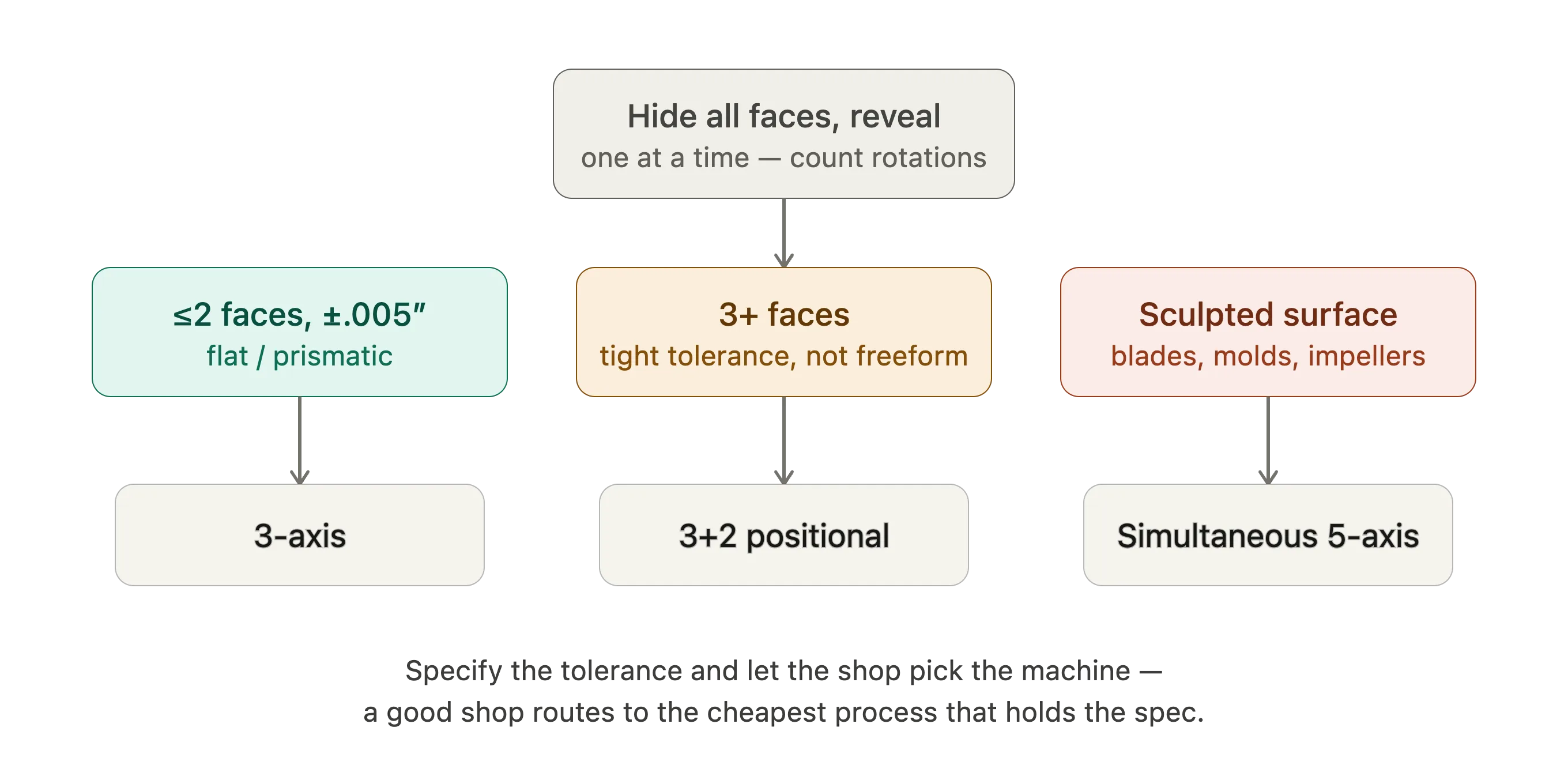
If most features can be reached from one or two directions, 3-axis machining is usually the most economical option.
If features are spread across multiple faces, a 5-axis machine may significantly reduce setup time and improve accuracy.
If the part contains complex curved surfaces, simultaneous 5-axis machining may be the best solution.
Final Thoughts
The question is not whether 5-axis machining is better than 3-axis machining.
The real question is whether your part geometry benefits from reducing setups.
For simple parts, a 3-axis machine often delivers the lowest cost. For components with features on multiple sides or demanding tolerances, 5-axis machining can improve efficiency, shorten lead times, and reduce the risk of costly errors.
The best manufacturing strategy is always the one that meets the design requirements with the fewest complications and the greatest consistency.