
Material Selection Guide for Semiconductor Equipment
Selecting the right material is one of the most important engineering decisions in semiconductor equipment design. While manufacturing processes such as CNC machining, sheet metal fabrication, injection molding, and casting determine how a component is produced, the material ultimately defines how that component performs throughout its life.
A material that performs well in one application may fail completely in another. Some materials offer excellent corrosion resistance but are difficult to machine.
Others provide exceptional strength but expand significantly with temperature changes. In semiconductor equipment, where micron-level accuracy, cleanroom compatibility, and long-term reliability are essential, choosing the wrong material can reduce equipment performance, increase maintenance, shorten component life, and ultimately affect semiconductor manufacturing yield.
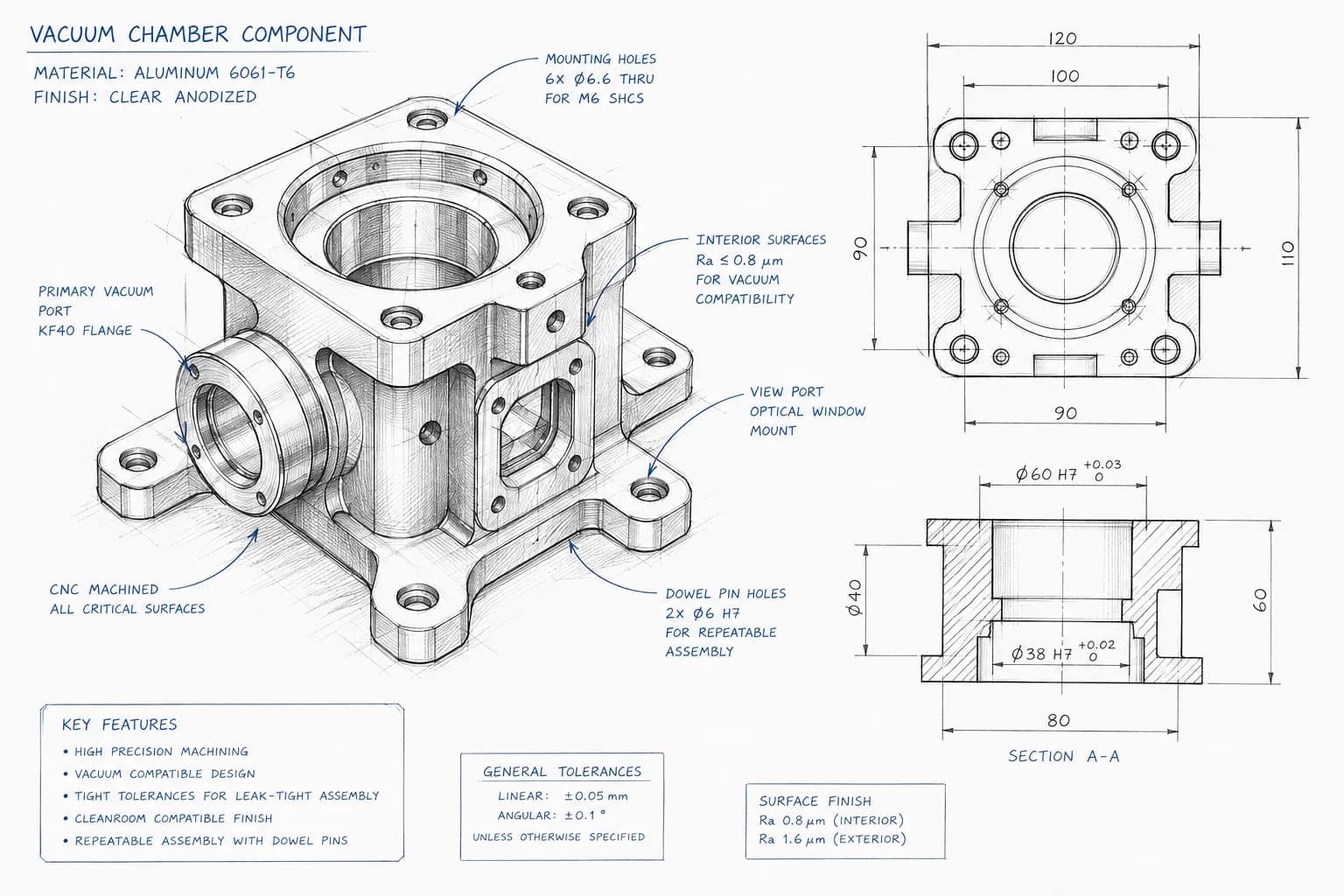
Unlike consumer products or general industrial machinery, semiconductor equipment operates in extremely controlled environments. Many components are exposed to vacuum conditions, aggressive process gases, high temperatures, plasma, chemicals, vibration, and continuous production cycles.
Mechanical structures must remain dimensionally stable over time while maintaining precise alignment with optical systems, robotic motion systems, and wafer handling mechanisms. Even a small amount of contamination or particle generation can impact wafer quality and reduce manufacturing efficiency.
Because of these demanding operating conditions, material selection is never based on a single property such as strength or cost.
Engineers evaluate multiple factors simultaneously, balancing mechanical performance, thermal stability, corrosion resistance, manufacturability, weight, cleanliness, cost, and long-term availability before selecting the most suitable material.
This guide explains how materials are selected for semiconductor equipment, why different materials are used for different applications, and the engineering trade-offs involved in choosing the right material for every component.
Why Material Selection Matters
Every mechanical component inside semiconductor equipment performs a specific function. Some provide structural support, others guide robotic motion, manage heat, contain vacuum, transport process gases, or protect sensitive electronics. Since every function places different demands on the material, no single material is suitable for every application.
For example, a lightweight structural frame benefits from aluminum because it offers excellent strength-to-weight ratio and is easy to machine.
A vacuum chamber, however, may require stainless steel to withstand corrosion, maintain vacuum integrity, and resist chemical attack. Components exposed to aggressive chemicals often rely on engineering plastics such as PEEK or PTFE, while thermal management systems frequently use copper because of its outstanding thermal conductivity.
Material selection directly influences:
- Equipment accuracy and dimensional stability
- Structural strength and rigidity
- Corrosion and chemical resistance
- Thermal expansion and heat dissipation
- Vacuum compatibility and outgassing
- Wear resistance and service life
- Manufacturing cost and lead time
- Ease of machining and fabrication
- Overall equipment reliability
Choosing the correct material at the beginning of a project helps reduce redesigns, improve manufacturability, and lower total production costs.
Factors Engineers Consider During Material Selection
Material selection is a balance between performance requirements and manufacturing practicality. Engineers evaluate several factors before finalizing a material.
Mechanical Properties
Components must withstand operational loads without excessive deformation. Engineers evaluate tensile strength, yield strength, hardness, fatigue resistance, and stiffness depending on the application.
For precision positioning systems, stiffness is often more important than maximum strength because structural deflection directly affects positioning accuracy.
Thermal Stability
Semiconductor equipment often experiences temperature fluctuations caused by heaters, plasma processes, motors, or cooling systems.
Materials expand when heated, but different materials expand at different rates. Excessive thermal expansion can cause alignment errors, dimensional changes, or loss of positioning accuracy. Materials with predictable thermal behavior help maintain precision throughout operation.
Corrosion Resistance
Many semiconductor manufacturing processes involve highly reactive chemicals and gases. Materials exposed to these environments must resist corrosion while maintaining dimensional integrity and surface quality. Corrosion resistance is especially important for:
- Wet processing equipment
- Chemical delivery systems
- Gas handling components
- Cleaning equipment
- Vacuum systems
Vacuum Compatibility
Many semiconductor manufacturing processes occur inside vacuum chambers. Materials used inside these systems must exhibit:
- Low outgassing
- Minimal particle generation
- Stable mechanical properties
- Excellent surface quality
Materials that release trapped gases or contaminants can negatively affect wafer processing.
Manufacturability
Even if a material offers excellent engineering properties, it must also be practical to manufacture. Engineers consider:
- Machining difficulty
- Weldability
- Formability
- Casting suitability
- Surface finishing options
- Material availability
Some high-performance materials significantly increase machining time and manufacturing cost.
Cost
Higher performance does not always justify higher cost. Good engineering aims to achieve the required performance without unnecessary material expense. Selecting a premium alloy where standard aluminum would perform equally well only increases project cost without improving functionality.
Common Materials Used in Semiconductor Equipment
Aluminum Alloys
Aluminum is one of the most widely used materials in semiconductor equipment. Its popularity comes from its excellent balance of weight, machinability, corrosion resistance, and cost.
Common grades: Aluminum 6061, Aluminum 6082, Aluminum 7075.
Typical applications: structural frames, precision plates, mounting brackets, robot arms, vacuum hardware, equipment panels.
Advantages: lightweight, easy to machine, good corrosion resistance, excellent strength-to-weight ratio, suitable for anodizing.
Limitations: lower wear resistance than steel, higher thermal expansion, reduced stiffness compared to steel.
Stainless Steel
Stainless steel is chosen where corrosion resistance, durability, and vacuum performance are priorities.
Common grades: 304 Stainless Steel, 316L Stainless Steel.
Typical applications: vacuum chambers, fluid systems, gas delivery systems, structural assemblies, process hardware.
Advantages: excellent corrosion resistance, high structural strength, good vacuum compatibility, long service life.
Limitations: heavy, more difficult to machine, higher manufacturing cost.
Titanium
Titanium combines high strength with low weight. It is commonly used where lightweight precision and corrosion resistance are required.
Applications: precision brackets, motion systems, vacuum hardware, high-performance assemblies.
Advantages: high strength, lightweight, excellent corrosion resistance, good fatigue resistance.
Limitations: expensive, difficult to machine.
Copper
Copper is selected primarily for thermal and electrical performance.
Applications: heat sinks, cooling plates, electrical contacts, thermal management systems.
Advantages: outstanding thermal conductivity, excellent electrical conductivity.
Limitations: heavy, soft material, poor wear resistance.
Engineering Plastics
Not every semiconductor component is made from metal. Engineering plastics provide excellent chemical resistance, electrical insulation, and lightweight performance.
PEEK
Used for: insulators, vacuum-compatible components, precision fixtures, high-temperature applications.
Advantages: excellent chemical resistance, high temperature capability, low particle generation, excellent dimensional stability.
PTFE
Commonly used for: seals, chemical handling, fluid transfer, insulation.
Advantages: extremely chemical resistant, very low friction, excellent electrical insulation.
Delrin (POM)
Applications: wear pads, precision guides, mechanical motion systems.
Advantages: easy to machine, good dimensional stability, low friction.
UHMW-PE
Applications: sliding surfaces, guide rails, wear strips.
Advantages: excellent wear resistance, low friction, impact resistant.
Surface Treatments and Material Performance
Material performance often depends on surface treatment rather than the base material alone. For example:
- Aluminum is frequently anodized to improve hardness and corrosion resistance.
- Stainless steel is passivated to enhance corrosion resistance.
- Steel components may receive nickel plating or powder coating for additional protection.
- Precision surfaces may be polished to reduce particle generation.
Selecting the correct combination of material and surface finish is often more important than selecting the material alone.
Material Selection Best Practices
Successful material selection begins with understanding the operating environment rather than simply choosing the strongest or most expensive material. Engineers should evaluate:
- Operating temperature
- Mechanical loads
- Chemical exposure
- Vacuum requirements
- Surface finish requirements
- Manufacturing process
- Production volume
- Cost targets
- Service life expectations
Balancing these factors early in product development helps improve manufacturability, reduce production costs, and increase long-term equipment reliability.
Conclusion
Material selection is a critical step in semiconductor equipment development because it directly affects performance, precision, durability, manufacturability, and overall product cost. The best material is rarely the strongest or the most expensive, it is the one that meets the application's mechanical, thermal, chemical, and manufacturing requirements while remaining practical to produce.
By carefully evaluating operating conditions, engineering requirements, manufacturing methods, and lifecycle costs, engineers can develop components that perform reliably in demanding semiconductor environments. Whether manufacturing precision aluminum structures, stainless steel vacuum assemblies, copper thermal components, or high-performance engineering plastics, selecting the right material lays the foundation for successful semiconductor equipment that delivers consistent performance from prototype through production.