
From Prototype to Production
How Cerakote Improves the Performance of 3D-Printed Parts:
3D printing allows engineers and product developers to create complex geometries quickly, but the performance and appearance of a printed part often depend on the finishing process applied after manufacturing. One finishing option gaining attention across aerospace, defense, automotive, medical, and industrial sectors is Cerakote coating.
Originally developed as a high-performance ceramic-based coating for firearms and military equipment, Cerakote has evolved into a versatile finishing solution for metal and polymer components. When applied to 3D-printed parts, it provides enhanced durability, environmental protection, and a professional appearance while maintaining dimensional accuracy.
What Is Cerakote?
Cerakote is a thin-film ceramic-polymer coating designed to improve surface performance. Unlike conventional paint or powder coating, Cerakote forms a highly durable protective layer that offers:
- Abrasion resistance
- Corrosion resistance
- Chemical resistance
- UV stability
- Improved wear performance
- Enhanced aesthetics
The coating is available in hundreds of colors, textures, and finishes, making it suitable for both functional and cosmetic applications.
Why Apply Cerakote to 3D-Printed Parts?
Many additive manufacturing processes produce parts with excellent geometry but surfaces that may be vulnerable to wear, UV exposure, moisture, or chemicals.
Cerakote addresses these limitations without significantly increasing part weight or altering critical dimensions.
Key Benefits
1. Improved Surface Durability
Raw polymer 3D-printed parts can experience scratching, abrasion, and surface wear during handling and operation.
Cerakote creates a protective ceramic layer that significantly improves resistance to:
- Surface scratches
- Friction wear
- Impact damage
- Repeated handling
This is particularly beneficial for production-grade prototypes and end-use components.
2. Enhanced Chemical Resistance
Industrial components are frequently exposed to:
- Oils
- Greases
- Cleaning agents
- Fuels
- Solvents
Cerakote provides a barrier that helps prevent chemical degradation and staining, extending component life in demanding environments.
3. UV and Weather Protection
Many polymer materials can discolor or degrade when exposed to sunlight for extended periods.
Cerakote improves resistance against:
- UV radiation
- Humidity
- Rain
- Outdoor weathering
This makes it suitable for outdoor equipment and exposed industrial applications.
4. Corrosion Protection for Metal Parts
For metal additive manufacturing processes such as DMLS or Binder Jetting, Cerakote provides an additional corrosion-resistant barrier.
Applications include:
- Aerospace brackets
- Industrial tooling
- Robotics components
- Defense equipment
5. Professional Cosmetic Finish
3D-printed parts often show visible layer lines, powder texture, or manufacturing marks.
After proper surface preparation, Cerakote delivers:
- Uniform appearance
- Consistent color
- Matte, satin, or gloss finishes
- Premium product aesthetics
This is particularly valuable for customer-facing products and trade show prototypes.
Compatibility with 3D Printing Technologies
Cerakote can be applied to a variety of additive manufacturing materials.
| 3D Printing Process | Compatibility |
|---|---|
| MJF (PA12, PA11) | Excellent |
| SLS Nylon | Excellent |
| FDM | Good |
| SLA Resin | Good |
| DMLS Metal Printing | Excellent |
| Binder Jet Metal | Excellent |
| PolyJet | Good |
Proper surface preparation is critical to achieve optimal adhesion and appearance.
Cerakote vs Traditional Finishing Methods
| Property | Cerakote | Paint | Powder Coat |
|---|---|---|---|
| Wear Resistance | Excellent | Moderate | Good |
| Chemical Resistance | Excellent | Moderate | Good |
| Corrosion Protection | Excellent | Moderate | Good |
| Coating Thickness | Thin | Thin | Thick |
| Dimensional Impact | Minimal | Minimal | Higher |
| Color Options | Extensive | Extensive | Extensive |
| Surface Hardness | High | Low | Moderate |
For precision components where tolerances matter, Cerakote often provides an advantage because of its relatively thin coating layer.
Common Applications for Cerakote-Coated 3D-Printed Parts
Aerospace Components
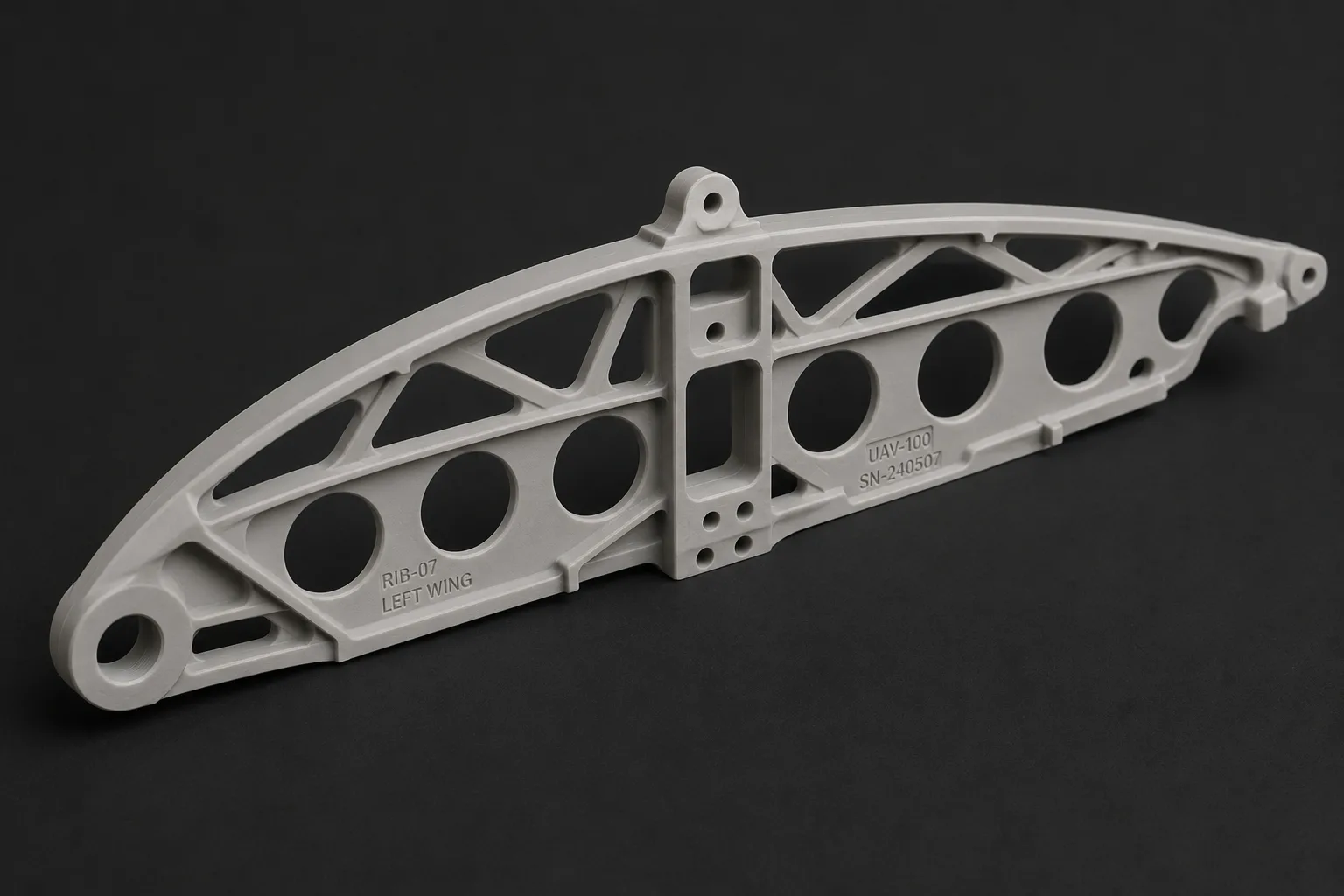
Applications include:
- Lightweight brackets
- UAV components
- Sensor housings
- Interior cabin parts
Benefits:
- Corrosion protection
- Reduced wear
- Professional appearance
Automotive Parts
Common examples include:
- Custom intake components
- Motorsports fixtures
- Interior trim pieces
- Prototype assemblies
Benefits:
- Heat resistance
- Chemical resistance
- Improved aesthetics
Robotics and Automation
Examples include:
- Robot joint covers
- End-of-arm tooling
- Sensor enclosures
- Machine components
Benefits:
- Scratch resistance
- Improved durability
- Reduced maintenance
Consumer Electronics
Examples include:
- Wearable housings
- IoT device enclosures
- Handheld equipment casings
Benefits:
- Premium finish
- Color customization
- Improved product appearance
Defense and Tactical Equipment
Applications include:
- Equipment housings
- Mounting brackets
- Ruggedized electronic enclosures
Benefits:
- Environmental protection
- Wear resistance
- Long-term durability
Design Considerations
Before specifying Cerakote for a 3D-printed component, engineers should consider:
Surface Preparation
Successful coating depends on:
- Cleaning
- Sanding
- Media blasting
- Surface smoothing
Higher-quality surface preparation generally results in a superior finish.
Tolerance Requirements
Although Cerakote is thin compared to powder coating, critical mating surfaces may require masking during application.
Examples include:
- Bearing seats
- Threaded interfaces
- Precision fits
- Sealing surfaces
Functional Requirements
Cerakote should be selected when the application requires:
- Enhanced wear resistance
- Environmental protection
- Cosmetic improvement
- Long-term durability
For purely visual prototypes, standard painting may be sufficient.
When Is Cerakote Worth the Extra Cost?
Cerakote is typically justified when parts are:
- Customer-facing products
- Production-grade prototypes
- Outdoor-use components
- Industrial equipment parts
- Aerospace or defense components
- Frequently handled assemblies
For low-cost concept models where durability is not important, simpler finishing methods may provide a better cost-to-benefit ratio.
Conclusion
Cerakote transforms 3D-printed parts from prototype-quality components into durable, professional-grade products capable of operating in demanding environments. Its combination of abrasion resistance, chemical protection, corrosion resistance, and premium aesthetics makes it an attractive finishing option for both polymer and metal additive manufacturing applications.
For engineering teams seeking to improve the durability and appearance of 3D-printed parts without significantly affecting weight or dimensional accuracy, Cerakote offers a practical and proven solution that bridges the gap between prototype and production-ready hardware.