
Prototyping Lead Time
Ask a shop how long a prototype takes and you'll get a number. Five days. Two weeks. Whatever it is, write it down, because it's almost never what actually happens. The part doesn't take two weeks. The part takes three days. The other eleven are spent waiting — on a quote, on a material that's out of stock, on a finishing vendor across town, on you to answer a question an email asked four days ago.
That's the thing nobody tells you when you start building hardware. Lead time isn't machine time. The machine is the fast part. Lead time is everything wrapped around the machine, and most of it is queue and back-and-forth, not cutting. Which is good news, in a way — because the stuff eating your timeline is mostly the stuff you can do something about.
So this is where the days actually go, process by process, and what you can do to get them back.
The Problem: You're Measuring the Wrong Thing
When you picture a prototype taking shape, you picture the machine running. That's the satisfying part — chips flying, a print growing, metal bending. It's also the part that takes the least time and that you have the least control over.
Pull apart a typical prototype timeline and the machining or printing is a sliver of it. The rest is quoting, ordering material, waiting in the shop's queue behind other jobs, secondary operations, finishing, inspection, and shipping. Then layer in the dead time that doesn't show up on anyone's schedule: the day your RFQ sat unanswered because it was missing a tolerance, the two days the shop waited on you to confirm a substitute material, the weekend the part spent on a loading dock.
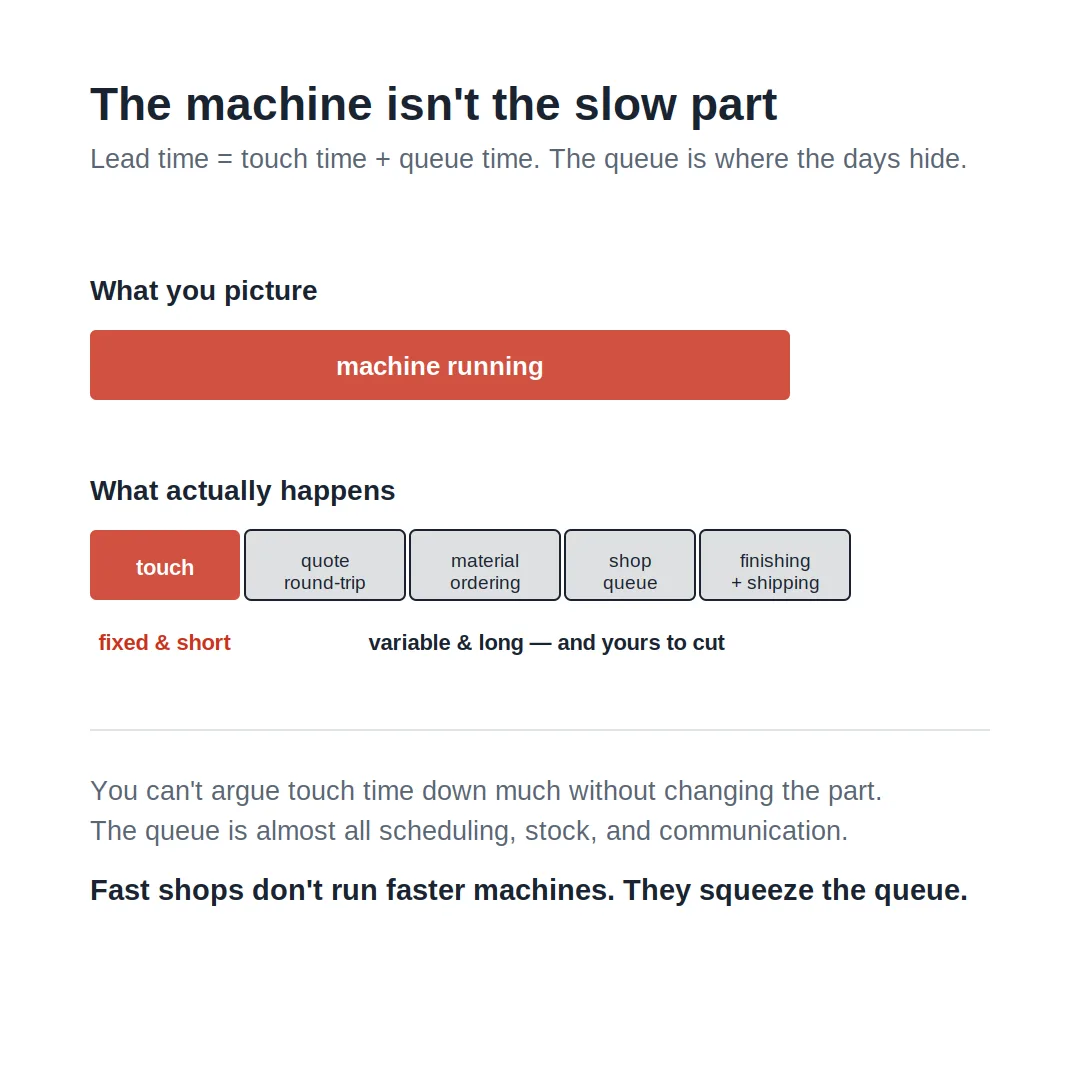
So when someone quotes you "five days," ask what that five days covers. Usually it's machine time and maybe a finish. It almost never includes the quoting round-trip, the material lead time, or the shipping. Those live in the gap between the quote and the part in your hands, and that gap is where your schedule quietly goes to die.
The shops that feel fast aren't running faster machines. They've squeezed the waiting.
The Core Idea: Lead Time Is Queue Time Plus Touch Time
Every prototype's clock is really two clocks added together.
Touch time is the part actually being worked — programmed, cut, printed, bent, finished, measured. It's real, it's mostly fixed by the process and the part, and it's surprisingly short. A machined bracket might be a few hours of touch time. A printed housing, overnight. Touch time is honest. You can't argue it down much without changing the part.
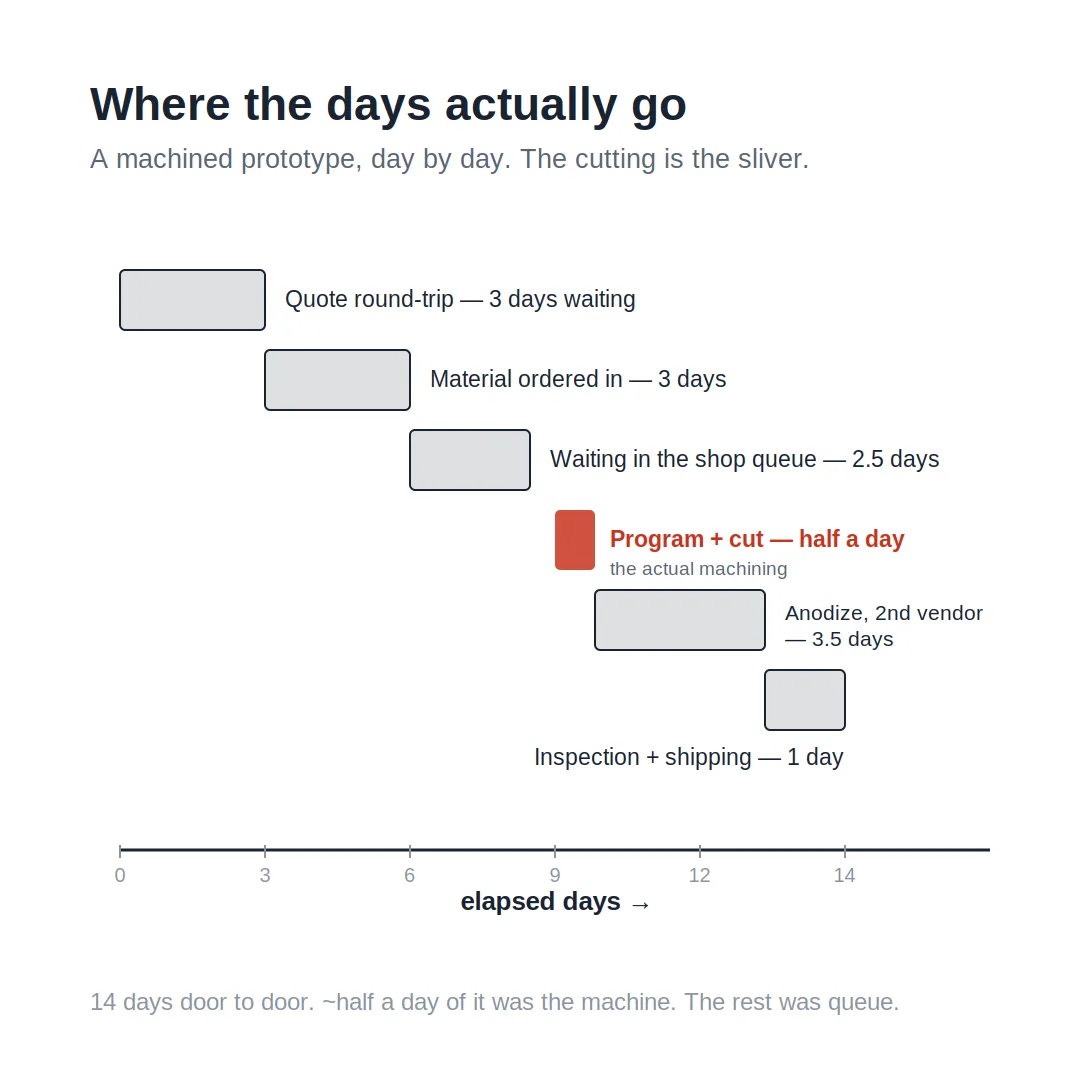
Queue time is everything else. The part waiting its turn on a busy machine. The quote sitting in someone's inbox. The material on a truck. The finishing vendor's lot not being full yet. Queue time is where the days hide, it's wildly variable, and it's almost entirely about scheduling, stock, and communication rather than anything physical.
Here's why this split matters: people try to cut lead time by chasing faster touch time — a quicker process, a rush on the machine. But touch time was never the problem. The win is in the queue. Get your RFQ complete so the quote turns around same-day instead of after three emails. Pick a material that's on the shelf instead of one that ships in a week. Choose a process whose queue is short this month. None of that touches the machine, and all of it moves the date.
The Mechanics: Where the Days Actually Go, Process by Process
CNC machining. The cutting is fast. What stretches a machined prototype is everything bracketing it. Programming and fixturing come first — a complex five-axis part needs real CAM time before a chip flies. Then material: if your alloy and stock size are on the shelf, you're moving; if the shop has to order bar stock or buy a full length to get one block, you've added days and paid for metal that ends up as chips. Then the shop's queue, because your part waits behind whatever's already clamped up. And then the killers at the end — anodizing, plating, powder coat — which almost always go to a second vendor with their own lot schedule and minimum batch. A part that machines in an afternoon can sit a week waiting for an anodize tank to fill. Tolerances feed in too: tight features mean slower cuts, mid-cycle inspection, and more scrap, all of which stretch the touch time and the risk of a re-run.
3D printing. Usually the fastest route to a first article, and that's exactly why it's the right call for early fit-checks and iteration — you can run the machine overnight and have something in hand by morning. But "printed overnight" isn't "done." Post-processing is the hidden tail: support removal, washing and curing on resin parts, bead blasting, dyeing, sometimes machining a critical feature the printer can't hold. The print is the short part. For early loops where you just need to hold the geometry and check fit, printing's short queue and overnight touch time are hard to beat — which is the whole reason it earns its place in the timeline even when the final part will be machined.
Sheet metal. Lead time here lives in two places: tooling and finishing. Cutting and bending are quick once the shop is set up, but if your part needs a special form tool or a punch they don't stock, you wait. And like machining, the finish is often a separate trip — plating, powder coat, silk screen — each with its own queue.
The trap is hardware and assembly:
PEM inserts, welding, a part that has to go out for plating and come back before final assembly. Every hand-off between operations is a fresh spot to sit in a queue.
The quoting round-trip — the delay nobody schedules.
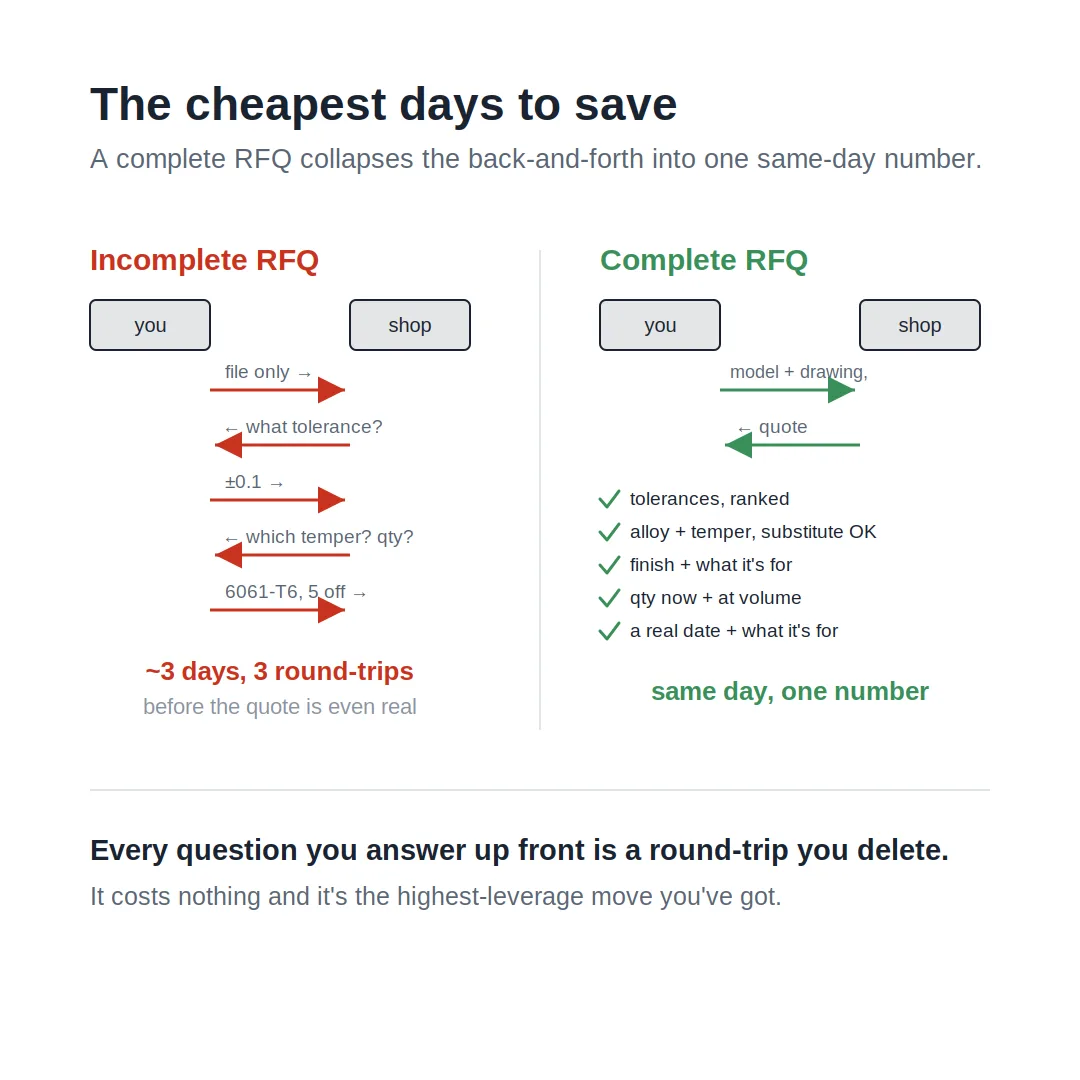
This one isn't a process step, but it eats more calendar than any single operation, and it's entirely self-inflicted. Send an incomplete RFQ and the clock doesn't start on your part — it starts on a conversation.
The shop emails back asking for the tolerance you didn't call out, the temper you left as "aluminium," the quantity you forgot, the date you never gave. Each round-trip is a day, sometimes two, and you can stack three of them before a single quote is even real. A complete RFQ collapses that whole back-and-forth into one same-day number. It's the cheapest days you'll ever save, and they're sitting right there.
The Tradeoffs: What You're Actually Choosing Between
Speed against cost. Speed is something you buy, the same as a tolerance or a finish. A rush job jumps the queue, bumps somebody else's part, and usually runs on overtime — and it's priced like it. The part you need Friday and the same part you need in four weeks are two different numbers. Worth paying when the schedule genuinely demands it; worth not paying when "ASAP" was really just nerves and the part could've waited a week at half the price.
Process against timeline. The fastest process to a first part isn't always the one you'll use for the real thing. A printed prototype in your hands tomorrow tells you about fit and geometry now, even if the production part will be machined. Reaching for the "correct" final process too early can cost you a week of waiting when a quick-and-dirty print would've answered the question you actually had today. Match the process to the question you're asking this loop, not to the end state.
Local against cheaper-but-distant. A shop down the road shaves shipping and makes the back-and-forth quick — drawings clarified in a phone call, parts collected same day. A cheaper shop further out adds transit on every iteration and turns every question into an email lag. On a one-off it might not matter. Over five iteration loops, the local shop's faster turns can beat the distant shop's lower per-part price on total time-to-done, even if each part costs a little more.
Tolerance against everything. This sits underneath all of it. Over-tighten features that don't need it and you've bought yourself slower cuts, extra inspection, more scrap, and more re-runs — time and money spent holding precision nothing actually uses. The instinct to tighten everything out of caution is the single most common self-inflicted delay there is. Tolerance is a schedule decision as much as a cost one.
The Practical Takeaway: How to Get the Days Back
The pattern across every process is the same. The machine is fast. The waiting is slow. So you attack the waiting.
Send a complete RFQ the first time.
This is the highest-leverage move you've got, and it costs nothing. Model plus a 2D drawing, exact alloy and temper, tolerances sorted into critical-versus-don't-care, finish with the job it's doing, the prototype quantity and where you're headed, a real date, and one line on what the part is for. Hand the shop complete intent and the quote comes back same-day instead of after a week of email tennis. Every question you answer up front is a round-trip you delete.
Pick on-the-shelf material unless you have a reason not to.
If a common alloy and a standard stock size will do, say so — and say whether a substitute is fine. It lets the shop quote what's already in the rack instead of ordering in, and that's days off the front of the job before a single cut.
Design the finishing out, or plan it in.
Secondary finishing is where prototypes quietly lose a week, because it usually means a second vendor and their batch schedule. If a part doesn't need anodizing to answer this loop's question, skip it and bare-metal the prototype. If it does, get it on the schedule early instead of discovering the lead time after the part's already cut.
Match the process to the question, not the product.
Early loops are about geometry and fit — print them, get them tomorrow, learn fast. Save the slower, "correct" process for when the question is about the real material or the real finish. Don't pay a week of queue time to answer a question a $20 print could've settled overnight.
Give a real date and ask what blows it up.
Put an actual deadline on the RFQ — vague urgency just lets the shop default to whatever suits their schedule, and then your real timeline turns out tighter than their guess. Then ask the shop directly what could push the date: material lead time, a full finishing queue, an inspection report. The delays that surprise you are almost always the ones nobody named out loud at the start.
Prototype lead time isn't a machine spec. It's a stack of queues and hand-offs with a little bit of cutting in the middle, and the cutting was never the slow part. Get the RFQ complete, keep the material common, plan the finishing, and match the process to the question you're actually asking — and you pull days out of the schedule without anything running faster. Skip it, and you'll spend another two weeks waiting on a part that only ever needed three days of work.