
Semiconductor Equipment Manufacturing: A Complete Guide
Every smartphone you unlock, every laptop you use, every electric vehicle you drive, and every AI model you interact with depends on one tiny but incredibly powerful invention: the semiconductor chip. These chips act as the brains of modern electronic devices, processing billions of calculations every second while consuming remarkably little power.
As technology continues to advance, semiconductor chips have become the foundation of almost every industry, including consumer electronics, telecommunications, automotive, aerospace, healthcare, industrial automation, and renewable energy.
But have you ever wondered how these tiny chips are actually made?
Contrary to what many people imagine, semiconductor chips are not assembled like conventional electronic products. They are manufactured through one of the world's most sophisticated production processes, where microscopic circuits are built layer by layer on ultra-pure silicon wafers inside highly controlled fabrication facilities known as semiconductor fabs.
These facilities operate around the clock using hundreds of specialized manufacturing machines that perform processes such as photolithography, deposition, etching, ion implantation, cleaning, metrology, inspection, and wafer handling.
These machines are engineering marvels in their own right.
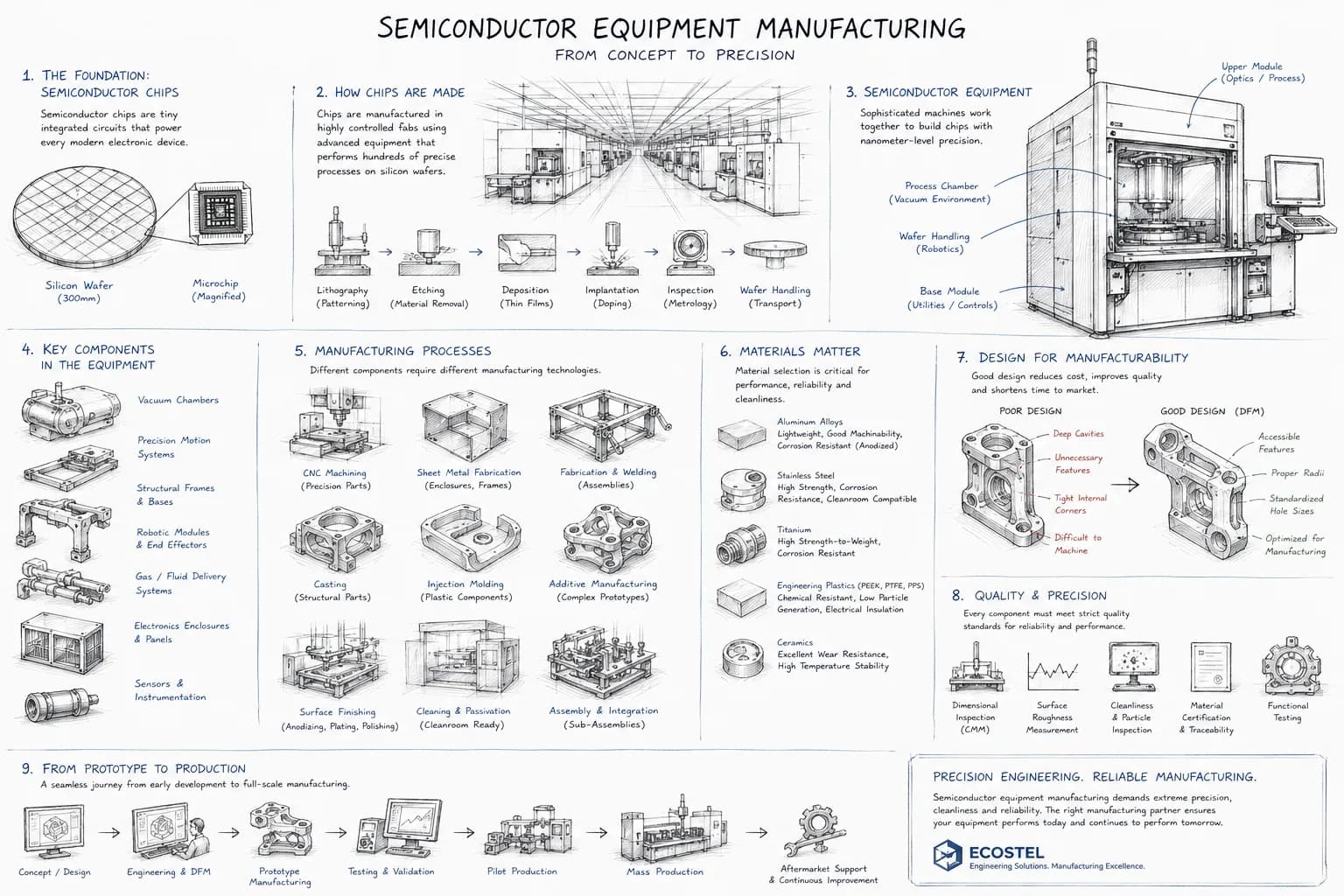
A single semiconductor manufacturing system may contain thousands of precision-engineered mechanical components, structural assemblies, motion systems, vacuum chambers, fluid distribution systems, sensors, electronic controls, and automation hardware.
Each component plays a critical role in maintaining the accuracy, stability, and repeatability required to manufacture semiconductor devices with features measured in nanometers, thousands of times smaller than the width of a human hair.
Unlike conventional industrial equipment, semiconductor manufacturing systems operate in extremely demanding environments.
Many processes take place inside vacuum chambers, while others require controlled temperatures, corrosive process gases, ultra-clean air, and vibration-free operation. Even microscopic particles or slight dimensional variations can affect manufacturing accuracy, reduce production yield, or impact the performance of the finished semiconductor device.
Because of this, every mechanical component must be carefully designed, manufactured, inspected, and assembled to exceptionally high quality standards.
This is where semiconductor equipment manufacturing becomes essential.
A Global Manufacturing Ecosystem
Although semiconductor companies are known for producing integrated circuits and advanced chips, a vast global manufacturing ecosystem exists behind the scenes to build the equipment that makes those chips possible.
Companies specializing in precision manufacturing produce the structural frames, machined components, vacuum hardware, precision sheet metal assemblies, tooling, brackets, manifolds, robotic components, cooling systems, enclosures, and countless other parts that make up semiconductor manufacturing equipment.
Producing these components requires a combination of advanced manufacturing technologies. Precision CNC machining creates highly accurate metal parts with tight tolerances. Sheet metal fabrication forms equipment enclosures, machine frames, and structural assemblies. Injection molding produces engineering plastic components such as cable management systems, covers, and insulators.
Casting is used for durable structural parts, while additive manufacturing enables rapid prototyping and complex geometries. Surface finishing processes such as anodizing, electroless nickel plating, passivation, polishing, and powder coating improve corrosion resistance, wear performance, cleanliness, and long-term reliability.
Choosing the Right Process
Selecting the right manufacturing process is only one part of the equation.
Engineers must also consider material properties, thermal stability, vibration characteristics, dimensional tolerances, assembly methods, production volumes, inspection requirements, and cleanroom compatibility. Every manufacturing decision influences the final performance, reliability, service life, and cost of the equipment.
This guide explores how semiconductor equipment is manufactured, the components that make up these highly advanced systems, the manufacturing processes behind them, the materials commonly used, and the engineering considerations that ensure consistent quality from prototype development through full-scale production.
Whether you're a design engineer, procurement professional, startup founder, or simply curious about the technology behind modern electronics, understanding semiconductor equipment manufacturing provides valuable insight into one of the most advanced and rapidly evolving industries in the world.