
SLA vs FDM
Choosing the Right 3D Printing Process for your parts..
3D printing has matured from a prototyping novelty into a legitimate manufacturing process — but "3D printing" is not one technology. It's a family of processes, each with distinct physics, materials, economics, and use cases.
The two most widely used are FDM (Fused Deposition Modeling) and SLA (Stereolithography), and choosing between them is one of the most common decisions hardware teams face when they need a part fast.
This article breaks down how each process works, where each one wins, and how to make the call for your specific application.
What is FDM 3D Printing?
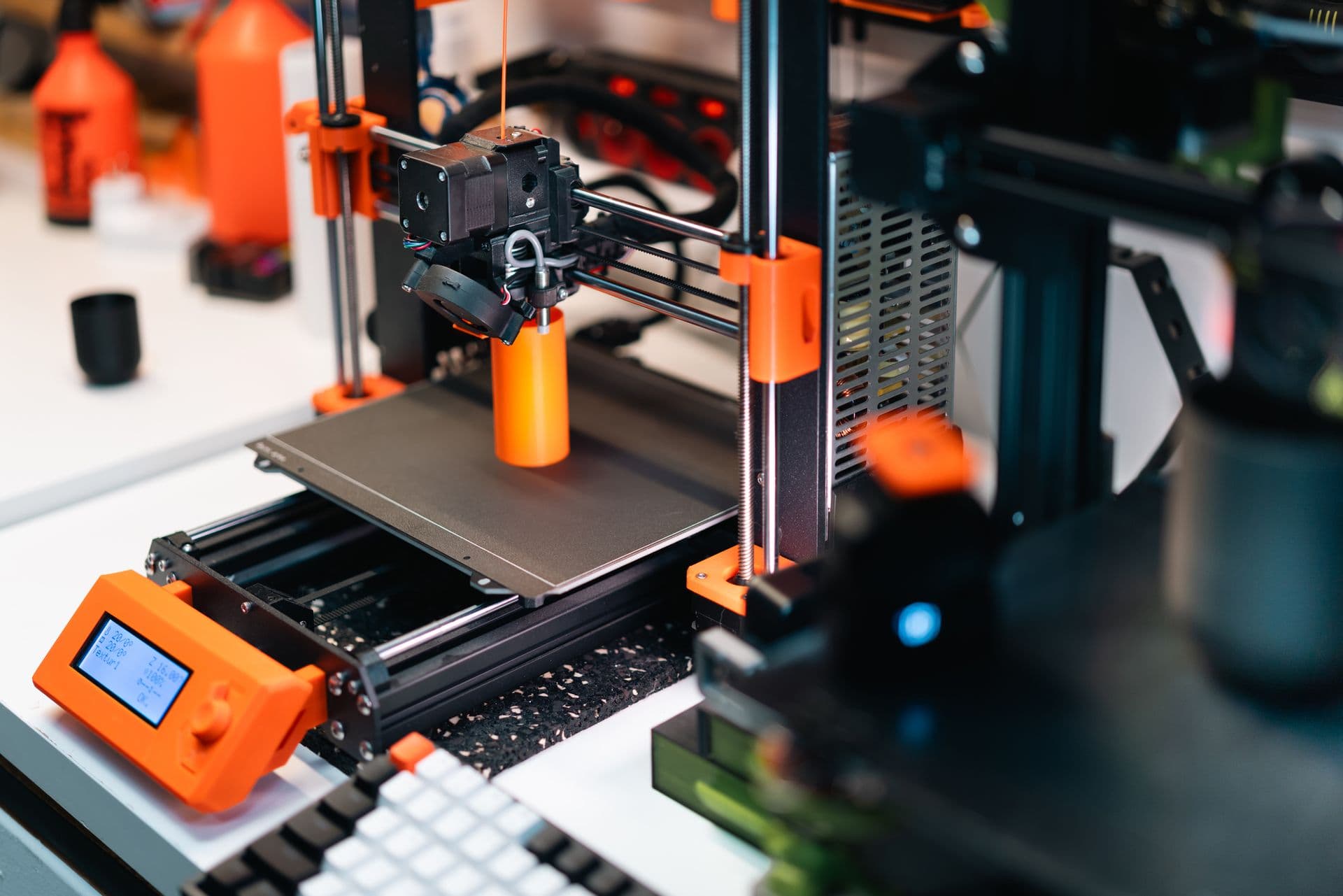
FDM is one of the most common and affordable 3D printing technologies available today.
The process works by feeding a plastic filament into a heated nozzle. The material melts and is deposited layer by layer until the part is complete.
Common FDM materials include:
- PLA
- ABS
- PETG
- Nylon
- TPU
- Polycarbonate
- Carbon Fiber Filled Materials
Because the part is built layer by layer, visible layer lines are common. The final part is generally strong and suitable for many functional applications.
Advantages of FDM
- Low cost
- Wide range of materials
- Strong functional parts
- Suitable for large components
- Fast turnaround for prototypes
Limitations of FDM
- Visible layer lines
- Lower surface quality
- Less detail on small features
- Lower dimensional accuracy compared to SLA
What is SLA 3D Printing?
SLA uses liquid resin instead of plastic filament.
A UV light source cures the liquid resin layer by layer to create the final part.
Because SLA uses light to form each layer, it can produce much finer details and smoother surfaces than FDM.
After printing, the parts must be washed and cured under UV light to achieve their final properties.
Common SLA resin types include:
- Standard Resin
- Tough Resin
- Flexible Resin
- High-Temperature Resin
- Castable Resin
- Biocompatible Resin
Advantages of SLA
- Excellent surface finish
- High dimensional accuracy
- Very fine details
- Smooth appearance
- Ideal for presentation models
Limitations of SLA
- Higher material cost
- Additional post-processing required
- Standard resins can be brittle
- Build size limitations
- Resin handling requires safety precautions
SLA vs FDM: Key Differences
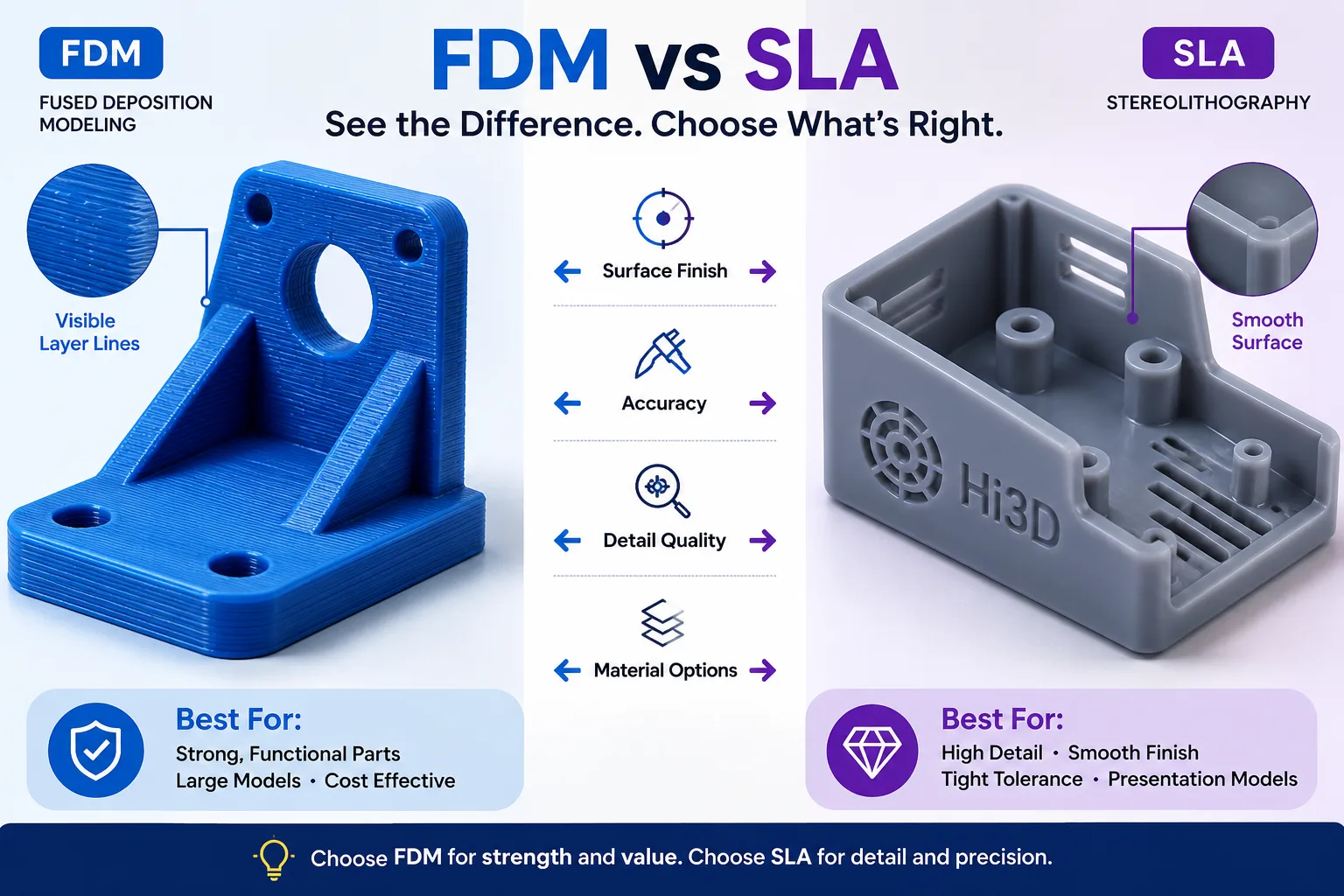
1. Surface Finish
When appearance matters, SLA is usually the better choice.
SLA parts have a smooth surface directly after printing and often require minimal finishing.
FDM parts typically show visible layer lines and may require sanding, painting, or other finishing processes.
2. Accuracy and Detail
SLA can produce much finer details than FDM.
Small text, thin walls, intricate features, and tight-fitting components are easier to achieve with SLA.
FDM works well for larger features but struggles with very fine details.
Winner: SLA
3. Strength and Durability
For functional parts, FDM often has the advantage.
Materials such as Nylon, ABS, PETG, and Polycarbonate offer excellent toughness and durability.
While engineering SLA resins have improved significantly, most standard resins remain more brittle than FDM plastics.
4. Material Options
FDM offers a wider range of engineering-grade plastics.
These materials are often similar to those used in production manufacturing, making them ideal for functional testing.
SLA offers specialized materials that are difficult to achieve with FDM, including:
- Dental resins
- Castable resins
- Flexible resins
- Biocompatible materials
Winner: Depends on the application
5. Part Size
FDM is generally better for large parts.
Large-format FDM printers are widely available and can produce enclosures, fixtures, tooling, and prototypes at a lower cost.
Large SLA parts become expensive because of resin consumption and machine limitations.
6. Cost
FDM is usually the more affordable option.
The equipment, materials, and post-processing requirements are generally lower than SLA.
SLA resin is more expensive, and additional washing and curing steps increase production costs.
7. Production Speed
The answer depends on the part.
For highly detailed small parts, SLA can be very efficient.
For larger parts and functional prototypes, FDM is often faster and more economical.
Winner: Depends on part geometry
Quick Comparison Table
| Feature | FDM | SLA |
|---|---|---|
| Surface Finish | Good | Excellent |
| Accuracy | Good | Excellent |
| Fine Details | Moderate | Excellent |
| Functional Strength | Excellent | Good |
| Material Selection | Wide Range | Specialized Resins |
| Large Parts | Excellent | Limited |
| Cost | Low | Medium to High |
| Post Processing | Minimal | Required |
| Visual Appearance | Moderate | Excellent |
When Should You Choose FDM?
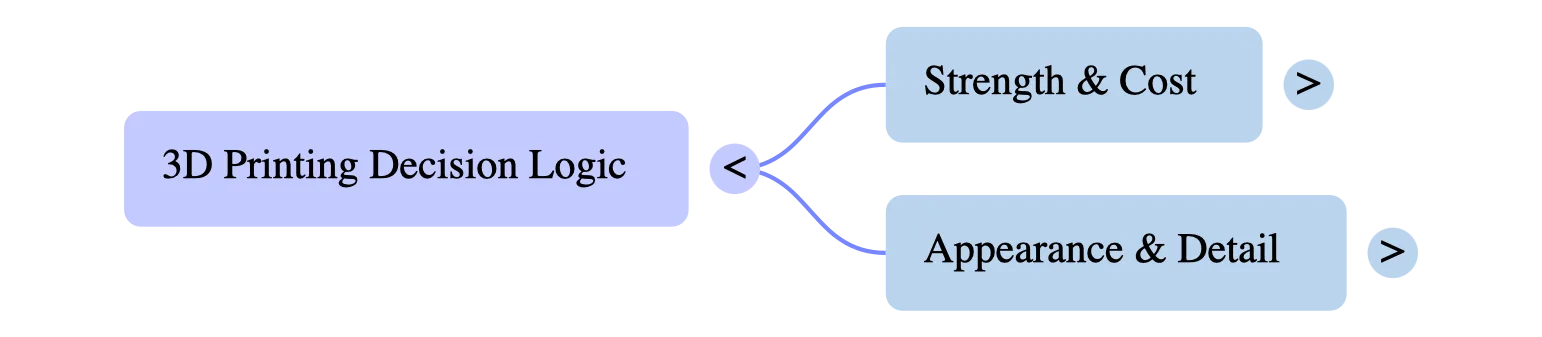
FDM is a good choice when:
- You need functional prototypes
- Strength is more important than appearance
- The part is large
- You need a cost-effective solution
- You require engineering-grade plastics
- Multiple design iterations are expected
Typical FDM Applications
- Product prototypes
- Manufacturing fixtures
- Assembly jigs
- Functional testing
- Industrial enclosures
- Robotics components
When Should You Choose SLA?
SLA is ideal when:
- Appearance is important
- Fine details are required
- Tight tolerances are needed
- The part will be used for presentations
- Smooth surfaces are critical
- Specialized resins are required
Typical SLA Applications
- Product display models
- Medical models
- Dental applications
- Jewelry patterns
- Fit and assembly testing
- Silicone mold master patterns
Common Mistakes When Choosing a Process
Choosing SLA for Heavy-Duty Functional Parts
Standard SLA resins can crack under repeated stress.
Choosing FDM for Highly Detailed Parts
Small text and intricate features may not print clearly.
Ignoring Post-Processing Requirements
SLA parts require washing and curing before use.
Focusing Only on Cost
The cheapest process is not always the best option if part quality is critical.
Which Process is Better?
There is no single winner.
The best choice depends on what your part needs to do.
Choose FDM when you need strong, affordable, functional parts.
Choose SLA when you need smooth surfaces, fine details, and high accuracy.
Many product development teams use both technologies. FDM is often used for early functional testing, while SLA is used later for appearance models, fit checks, and customer presentations.
The best approach is to select the process based on the part's requirements, performance expectations, and budget rather than choosing one technology for every project.
Final Thoughts
Both SLA and FDM are valuable manufacturing tools. Understanding their strengths and limitations helps engineers, designers, and product teams make better decisions during product development.
If your priority is strength, affordability, and large part sizes, FDM is often the better option. If your priority is appearance, accuracy, and fine detail, SLA is usually the right choice.
By matching the technology to the application, you can reduce costs, shorten development cycles, and achieve better results from your 3D printing projects.