
What Types of Gears Are Used in Robotics and Why?
Introduction
Gears are among the most important mechanical power transmission components in robotic systems. Although electric motors are the primary source of motion in most modern robots, they rarely deliver the torque and speed characteristics required for direct operation of robotic joints. Instead, gears are employed to modify rotational speed, amplify torque, improve positional accuracy, and transmit motion between mechanical components. Every industrial manipulator, collaborative robot, mobile robot, humanoid robot, and service robot relies on one or more gear systems to achieve controlled and efficient motion.
The selection of a gear type is one of the most critical mechanical design decisions in robotics. Unlike conventional machinery, robotic systems demand high positioning accuracy, compact size, low backlash, lightweight construction, and smooth dynamic performance. These requirements often conflict with one another. For example, increasing gear reduction improves output torque but also introduces additional inertia and transmission losses. Similarly, selecting a gearbox with minimal backlash enhances positioning accuracy but increases manufacturing complexity and cost. Therefore, the choice of gear depends not only on torque transmission requirements but also on the robot's intended application, precision, operating speed, payload capacity, and manufacturing constraints.
This article examines the major types of gears used in robotics, their operating principles, engineering advantages, limitations, and the reasons they are selected for specific robotic applications.
The Role of Gears in Robotics
Electric motors typically operate at rotational speeds ranging from 2,000 to 10,000 rpm while producing relatively low torque. Most robotic joints, however, require slow rotational speeds with significantly higher torque to move links, payloads, and end effectors accurately. Gear systems bridge this mismatch by reducing speed and proportionally increasing torque.
The fundamental relationship governing an ideal gear system is output torque = input torque × gear reduction ratio. Considering gearbox efficiency, output torque = input torque × reduction ratio × efficiency.
For example, a servo motor producing 1.5 N·m of torque connected to a 100:1 gearbox with an efficiency of 90% delivers 1.5 × 100 × 0.90 = 135 N·m. Thus, a relatively small motor can generate sufficient torque to move an industrial robotic arm carrying substantial payloads.
Similarly, output speed = motor speed ÷ reduction ratio. If the motor rotates at 3000 rpm through a 100:1 gearbox, output speed = 3000 ÷ 100 = 30 rpm. This reduced speed enables smooth and precise robotic motion.
Spur Gears
Spur gears are the simplest and most widely recognized gear type. Their teeth are cut parallel to the axis of rotation, allowing power transmission between parallel shafts.
Because of their straightforward geometry, spur gears are relatively inexpensive to manufacture and exhibit high mechanical efficiency, typically between 95% and 98%. They are frequently used in educational robots, small automation systems, conveyor mechanisms, and low-cost robotic devices where moderate precision is acceptable.
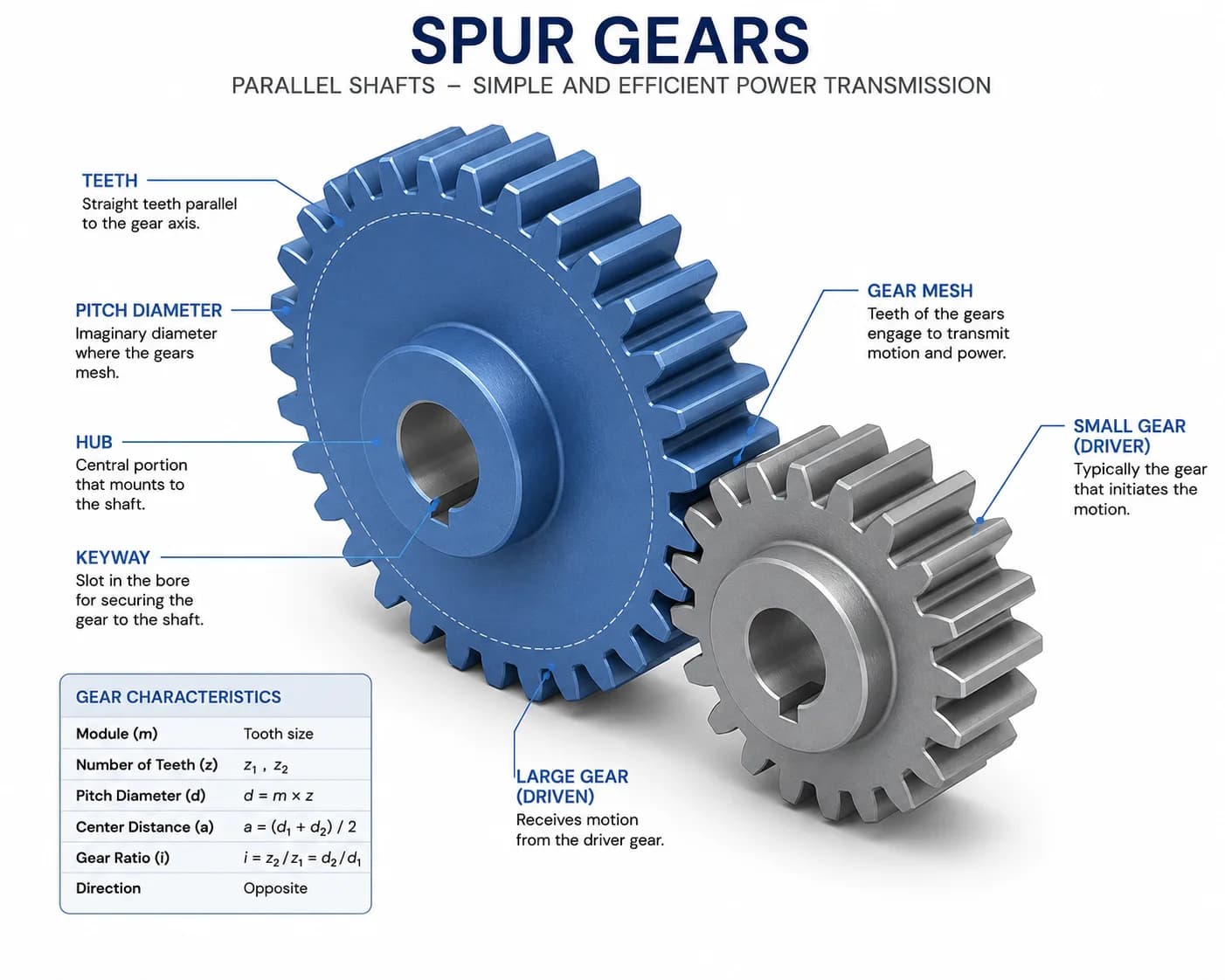
However, spur gears engage suddenly as individual teeth come into contact, resulting in increased vibration and noise at higher rotational speeds. They also exhibit measurable backlash unless manufactured with extremely tight tolerances. Consequently, spur gears are seldom used directly in high-precision robotic joints that require sub-millimeter positioning accuracy.
Despite these limitations, spur gears remain valuable wherever simplicity, low manufacturing cost, and ease of maintenance are the primary design objectives.
Helical Gears
Helical gears represent an improvement over spur gears by employing teeth cut at a helix angle rather than parallel to the shaft.
The gradual engagement of multiple teeth distributes transmitted loads more evenly, reducing vibration and operating noise while increasing load-carrying capacity. The larger contact ratio also improves durability and smoothness, making helical gears well suited for industrial robotic gearboxes operating under continuous cyclic loading.
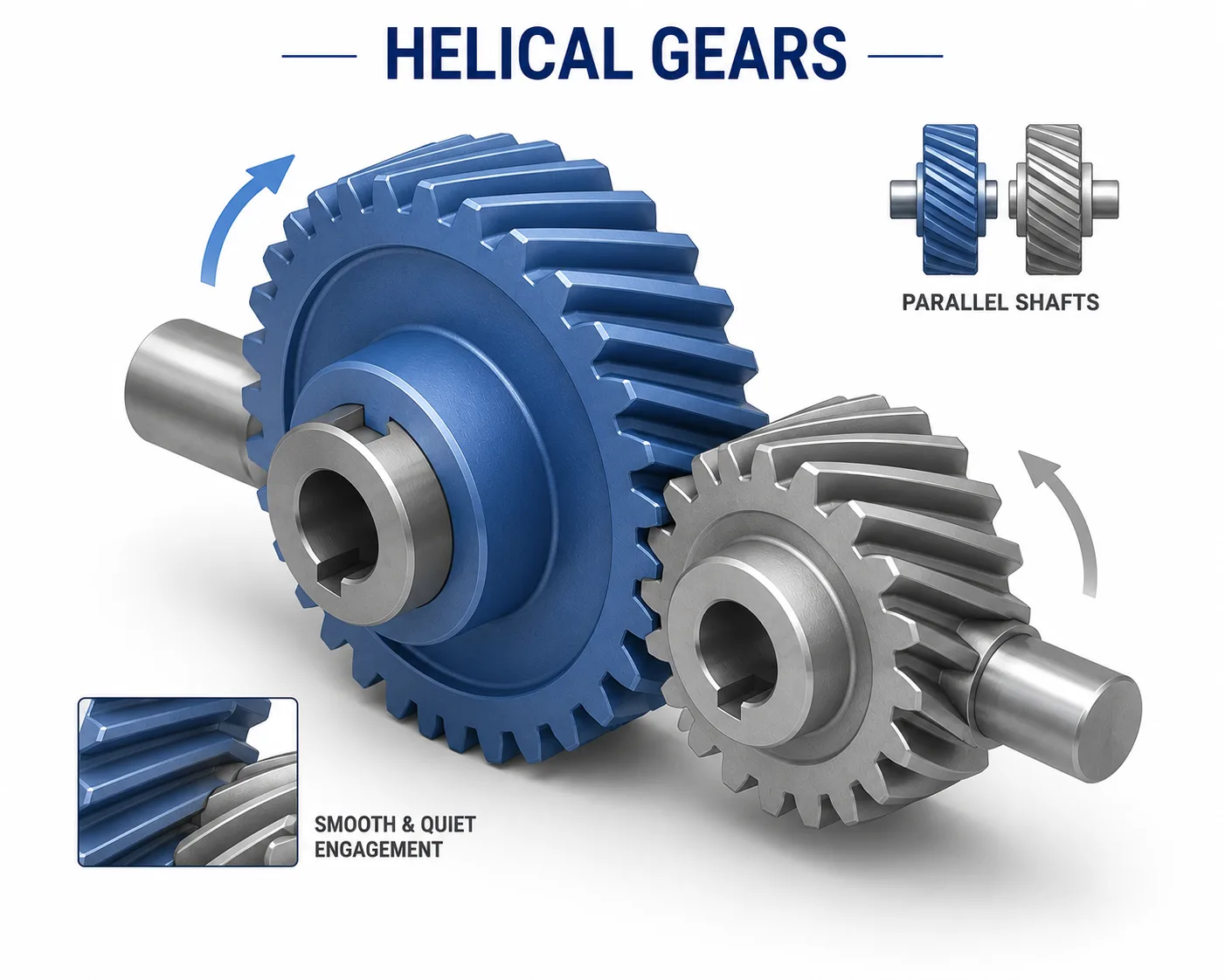
The principal disadvantage is the generation of axial thrust forces. Bearings must therefore support both radial and axial loads, increasing gearbox complexity. Manufacturing helical gears is also more demanding because of their complex tooth geometry.
Nevertheless, the smoother operation and higher torque capacity make helical gears one of the most common gear types in industrial robotic transmissions.
Planetary Gear Systems
Planetary gearboxes, also known as epicyclic gear systems, are among the most extensively used transmissions in robotics.
A planetary gearbox consists of a central sun gear, multiple planet gears, a surrounding ring gear, and a planet carrier. Unlike conventional gear trains, torque is shared among several planet gears simultaneously, allowing exceptionally high torque density within a compact housing.
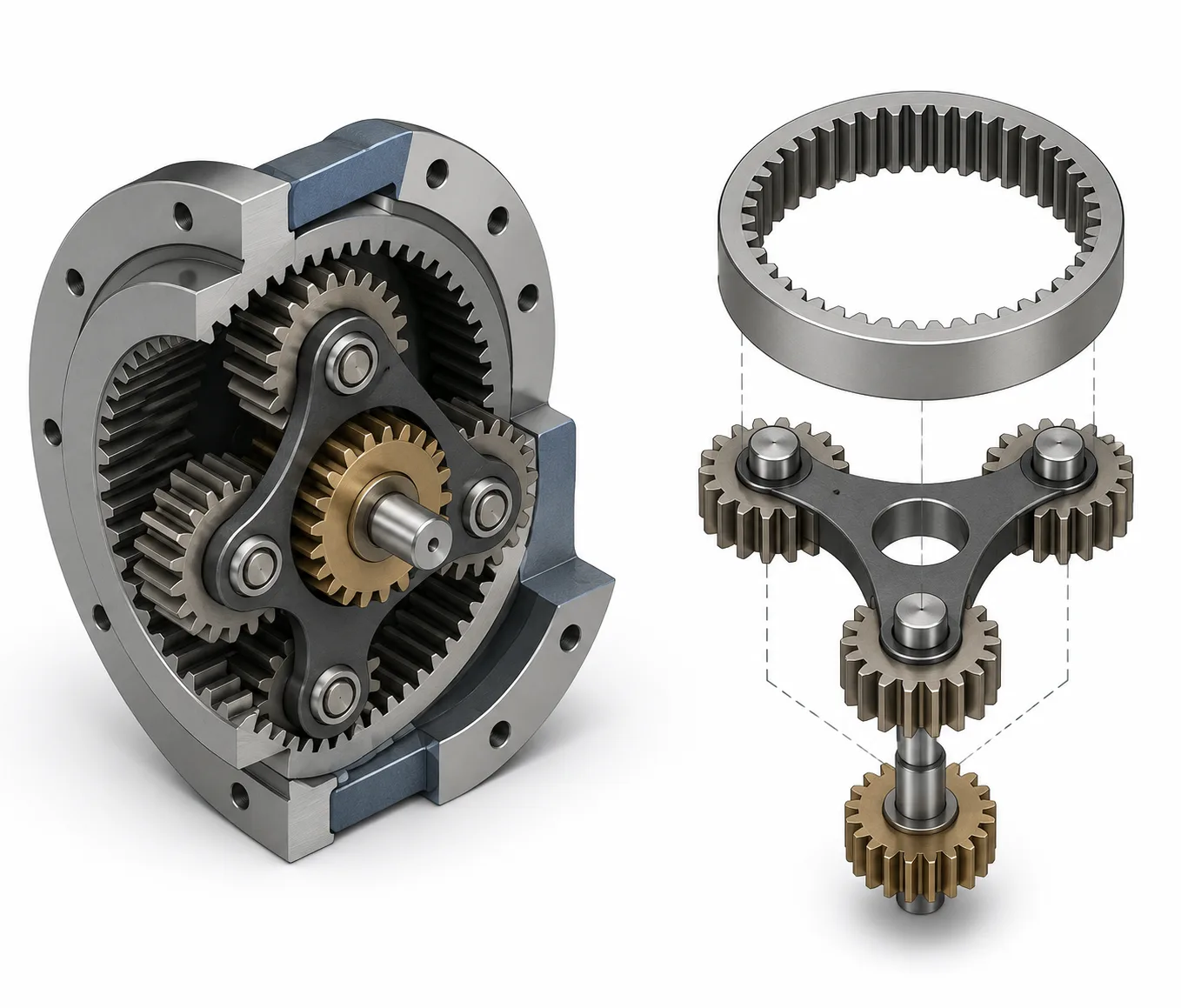
Planetary gearboxes offer several engineering advantages: high torque capacity, compact dimensions, coaxial input and output shafts, excellent load distribution, high transmission efficiency, and multiple available reduction ratios.
These characteristics explain why planetary gearboxes are widely employed in industrial robotic joints, mobile robots, autonomous guided vehicles (AGVs), and collaborative robots.
Typical reduction ratios range from 3:1 to over 100:1 through multiple gear stages while maintaining efficiencies exceeding 90%.
Harmonic Drive Gears
Among all robotic transmission systems, harmonic drives have become the preferred solution for precision articulated robots.
A harmonic drive consists of three principal components: the circular spline, the flex spline, and the wave generator.
Unlike traditional gears that rely on rigid tooth engagement, harmonic drives employ controlled elastic deformation of the flex spline to achieve motion transmission. As the wave generator rotates, it continuously deforms the flexible gear, causing controlled tooth engagement over two opposite regions.
This unique operating principle provides several exceptional advantages: nearly zero backlash, extremely high reduction ratios, compact size, lightweight construction, and excellent positioning accuracy.
Reduction ratios commonly range from 50:1 to 160:1 within a single stage.
Because robotic positioning errors accumulate along serial kinematic chains, minimizing backlash is essential. Even a small angular error in an early joint can produce significant positional errors at the end effector. Harmonic drives largely eliminate this problem, making them the transmission of choice for industrial manipulators, surgical robots, satellite positioning systems, and collaborative robots.
Their primary disadvantages include higher manufacturing cost, lower shock-load tolerance, and finite fatigue life of the flex spline.
Bevel Gears
Bevel gears transmit power between intersecting shafts, typically arranged at 90°.
In robotics, they are commonly used where rotational motion must change direction without introducing belts or chains. Wrist joints, steering mechanisms, and compact transmission systems frequently incorporate bevel gears.
Spiral bevel gears are generally preferred over straight bevel gears because they operate more smoothly and possess greater load capacity.
Worm Gears
Worm gear systems consist of a worm screw meshing with a worm wheel.
They provide extremely large reduction ratios within a compact package and possess a unique characteristic known as self-locking. Under certain operating conditions, external loads cannot back-drive the worm gear.
This property makes worm gears particularly useful in robotic lifting mechanisms, adjustable positioning devices, and manipulators that must maintain position even when electrical power is removed.
However, worm gears suffer from significant sliding friction, resulting in efficiencies often between 50% and 90%, depending on reduction ratio and lubrication. Consequently, they generate more heat than other gear systems and are generally unsuitable for high-speed robotic joints requiring maximum efficiency.
Rack and Pinion Systems
Although not commonly associated with rotary robotic joints, rack and pinion systems play an important role wherever rotational motion must be converted into linear motion.
Industrial Cartesian robots, gantry systems, warehouse automation equipment, and robotic transfer systems frequently employ rack and pinion mechanisms because they provide long travel distances, relatively high speeds, and excellent repeatability.
Compared with ball screw systems, rack and pinion drives permit virtually unlimited travel lengths, making them attractive for large-scale automation.
Why Harmonic and Planetary Gears Dominate Modern Robotics
Modern robotic systems increasingly favor harmonic drives and planetary gearboxes because they satisfy the demanding performance requirements of precision automation.
Harmonic drives provide outstanding positioning accuracy through negligible backlash and high reduction ratios, making them ideal for articulated robotic joints where repeatability is paramount.
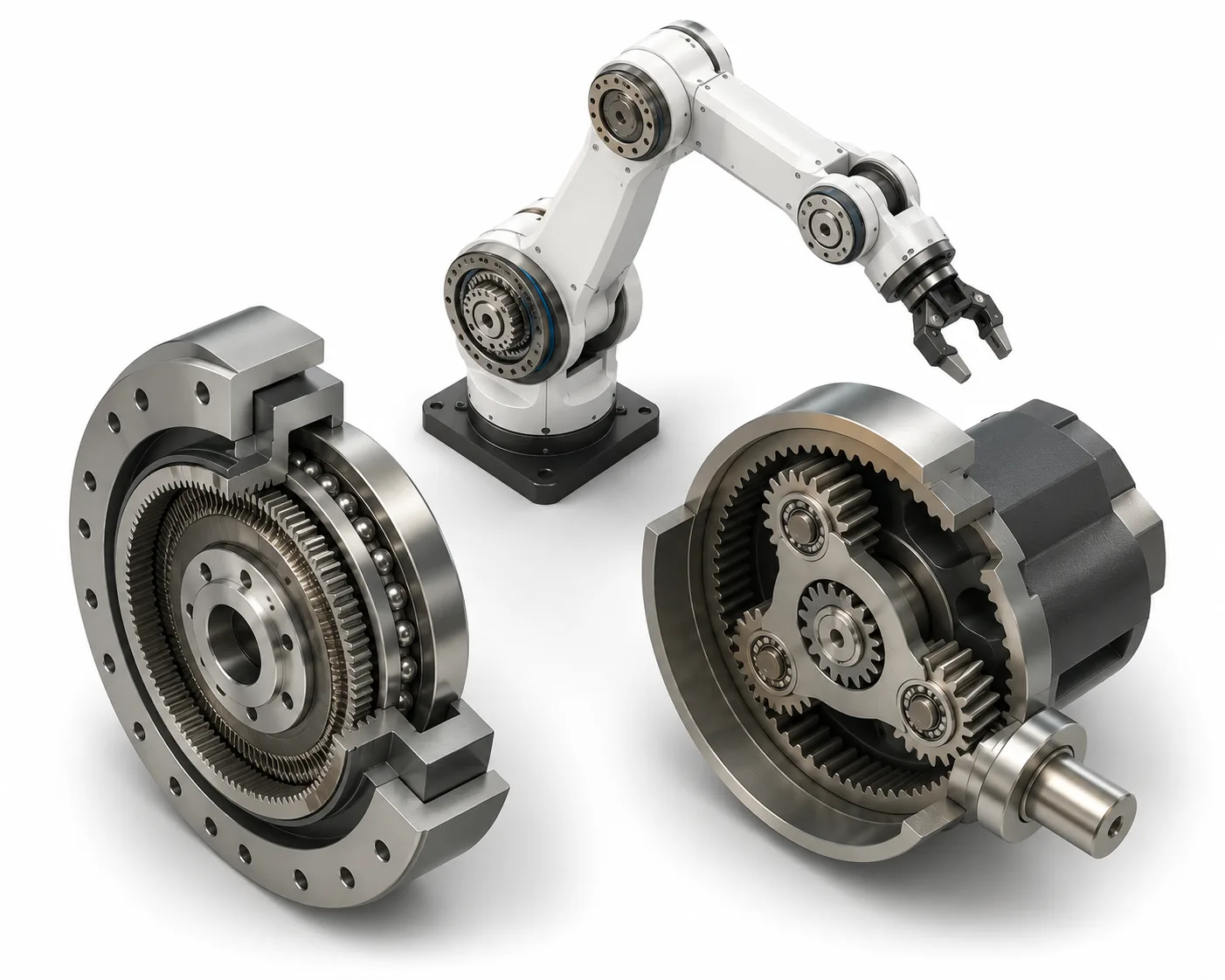
Planetary gearboxes, in contrast, excel in applications requiring high torque density, compactness, robustness, and efficient power transmission. Their balanced load sharing among multiple planet gears allows them to withstand heavy cyclic loading while maintaining long service life.
Many advanced industrial robots combine these technologies, using harmonic drives for precision joints such as the wrist and planetary gearboxes for larger base joints where higher torque capacity is required.
Design Considerations for Gear Selection
Selecting a gear system involves evaluating numerous engineering parameters rather than considering gear ratio alone. Important factors include:
- Required output torque
- Desired reduction ratio
- Positioning accuracy
- Backlash tolerance
- Transmission efficiency
- Load capacity
- Available installation space
- Dynamic response
- Maintenance requirements
- Manufacturing cost
- Expected service life
The optimal gear is therefore application-specific. A low-cost educational robot may perform effectively with spur gears, whereas an industrial welding robot requires precision transmissions such as harmonic drives to achieve repeatable motion under heavy cyclic loading.
Conclusion
Gears form the mechanical foundation of robotic motion transmission, enabling electric motors to deliver the torque, speed, and precision required for modern automation. Although numerous gear types are available, each possesses distinct mechanical characteristics that influence robotic performance. Spur gears offer simplicity and economy, helical gears provide smoother operation, bevel gears redirect power, worm gears deliver compact high reductions with self-locking capability, planetary gearboxes achieve exceptional torque density, and harmonic drives provide unparalleled precision with virtually zero backlash.
The widespread adoption of planetary and harmonic gear systems in advanced robotics reflects the increasing demand for compact, lightweight, and highly accurate mechanisms capable of operating reliably under continuous dynamic loading. As robots become faster, lighter, and more intelligent, future gear technologies will continue to evolve through advanced materials, precision manufacturing, optimized tooth geometries, and integrated sensing. Nevertheless, the fundamental purpose of gears, to efficiently transmit and control mechanical power, will remain central to robotic engineering for decades to come.