
Warehouse Automation with AGVs and AMRs
Introduction
Warehouse operations have undergone a remarkable transformation over the past decade. The rapid growth of e-commerce, increasing customer expectations for same-day deliveries, labor shortages, and the need for operational efficiency have driven organizations to embrace warehouse automation.
At the heart of this transformation are Automated Guided Vehicles (AGVs) and Autonomous Mobile Robots (AMRs). These intelligent systems automate repetitive material handling tasks, reduce operational costs, improve workplace safety, and enable warehouses to operate around the clock with greater precision.
According to industry analyses, warehouse automation has become one of the fastest-growing applications within industrial robotics, with autonomous mobile systems playing a central role in modern logistics ecosystems. The transition from fixed automation toward intelligent, AI-enabled mobile robots represents one of the most significant developments in Industry 4.0.
Warehouse Automation
Warehouse automation refers to the use of robotics, software, sensors, artificial intelligence, and data analytics to perform warehouse operations with minimal human intervention.
Typical automated warehouse activities include:
- Receiving goods
- Inventory transportation
- Order picking
- Sorting
- Packaging
- Pallet movement
- Inventory tracking
- Shipping preparation
Rather than replacing workers entirely, automation enables employees to focus on higher-value activities such as supervision, quality assurance, inventory optimization, and exception handling.
What Are Automated Guided Vehicles (AGVs)?
An Automated Guided Vehicle (AGV) is a mobile robot designed to transport materials by following predefined paths. Unlike autonomous robots, AGVs typically navigate using magnetic tape, QR codes, reflective markers, wired guidance, or laser guidance.
Because AGVs operate on fixed routes, they are highly reliable in predictable warehouse environments.
Common AGV types: pallet movers, tugger AGVs, forklift AGVs, unit-load carriers, and heavy-load transport vehicles.
Advantages: highly reliable transportation, excellent for repetitive tasks, lower operational errors, increased worker safety, and ideal for structured warehouse layouts.
Limitations: limited flexibility, route modifications require infrastructure changes, less suitable for dynamic environments, and obstacle handling is relatively basic.
What Are Autonomous Mobile Robots (AMRs)?
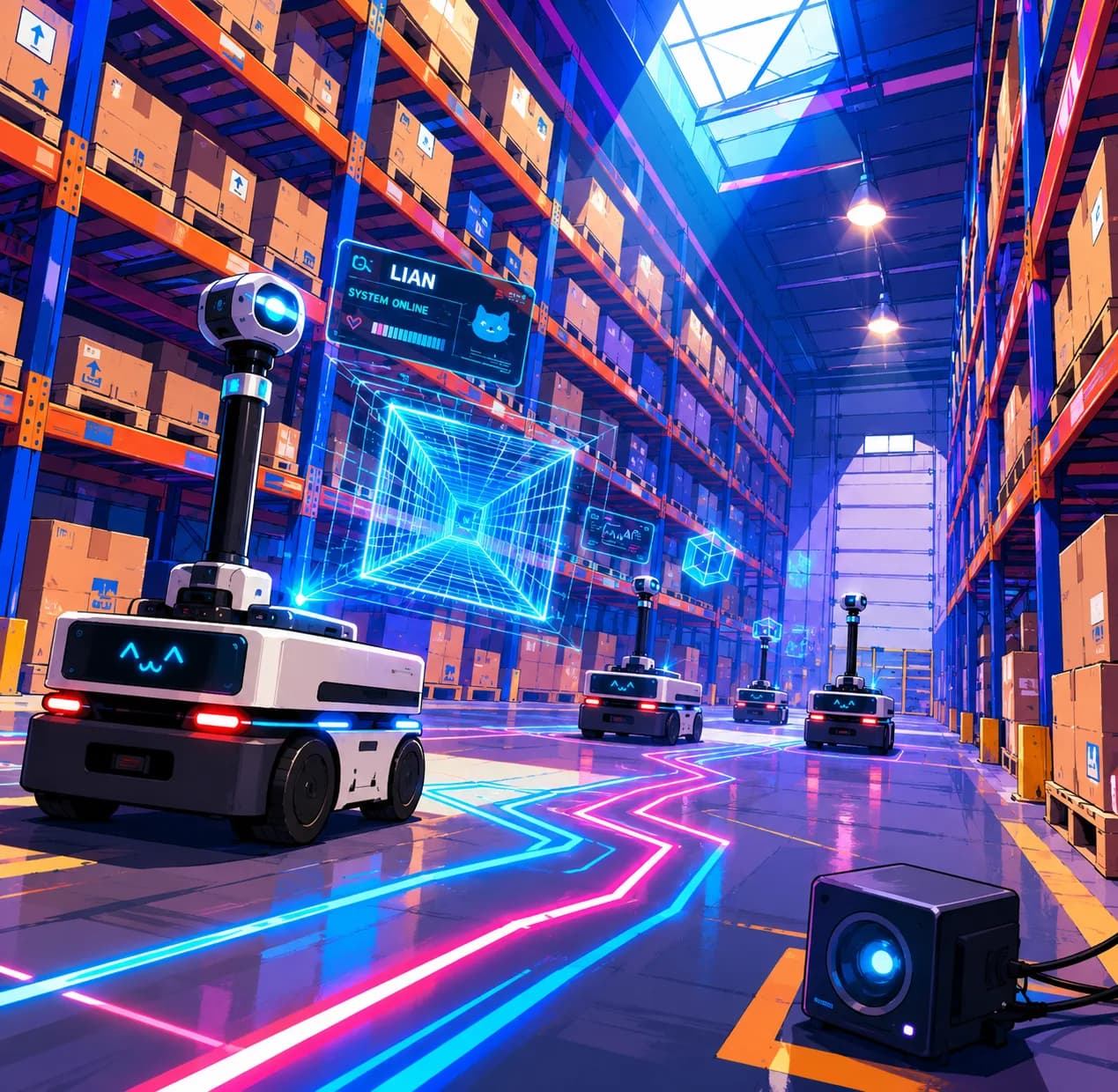
Autonomous Mobile Robots represent the next generation of warehouse mobility. Instead of following fixed paths, AMRs use advanced technologies including artificial intelligence, machine vision, LiDAR, Simultaneous Localization and Mapping (SLAM), 3D cameras, and edge computing.
These capabilities allow AMRs to create maps, detect obstacles, select optimal routes, re-plan paths instantly, navigate around workers safely, and learn from warehouse conditions.
This shift toward intelligent, modular robot systems reflects the broader movement from rule-based automation to goal-based autonomy highlighted in the robotics outlook.
AGVs vs. AMRs
| Feature | AGVs | AMRs |
|---|---|---|
| Navigation | Fixed routes | Dynamic navigation |
| Intelligence | Low | High |
| Infrastructure | Requires physical guidance | Minimal infrastructure |
| Obstacle Avoidance | Limited | Advanced AI |
| Flexibility | Low | High |
| Deployment Speed | Moderate | Fast |
| Scalability | Moderate | Excellent |
| Best Use | Predictable transport | Dynamic fulfillment |
Applications
AGVs and AMRs support a wide range of warehouse operations, including:
- Inventory transportation
- Order picking
- Goods-to-person fulfillment
- Cross-docking
- Inventory auditing
- Warehouse cleaning
Challenges of Implementation
Organizations should also plan for high upfront investment, integration with Warehouse Management Systems (WMS), workforce training, cybersecurity, fleet coordination, maintenance, and change management.
Industry Use Cases
Warehouse automation is widely adopted across sectors such as e-commerce fulfillment, retail distribution, automotive manufacturing, food and beverage logistics, pharmaceuticals, electronics manufacturing, and third-party logistics (3PL).
As robotics become more affordable and easier to program, adoption is expanding beyond large enterprises to smaller manufacturers and logistics operators.
The Future of Warehouse Automation
The next generation of warehouse robots will feature AI-driven fleet orchestration, swarm robotics, predictive maintenance, digital twins, human–robot collaboration, 5G-enabled communication, edge AI, self-learning navigation, and fully autonomous fulfillment centers.
Future warehouses will increasingly operate as interconnected ecosystems in which robots, sensors, software, and human workers collaborate in real time. The emphasis will continue shifting from isolated automation toward intelligent, adaptable systems capable of responding to changing operational demands.